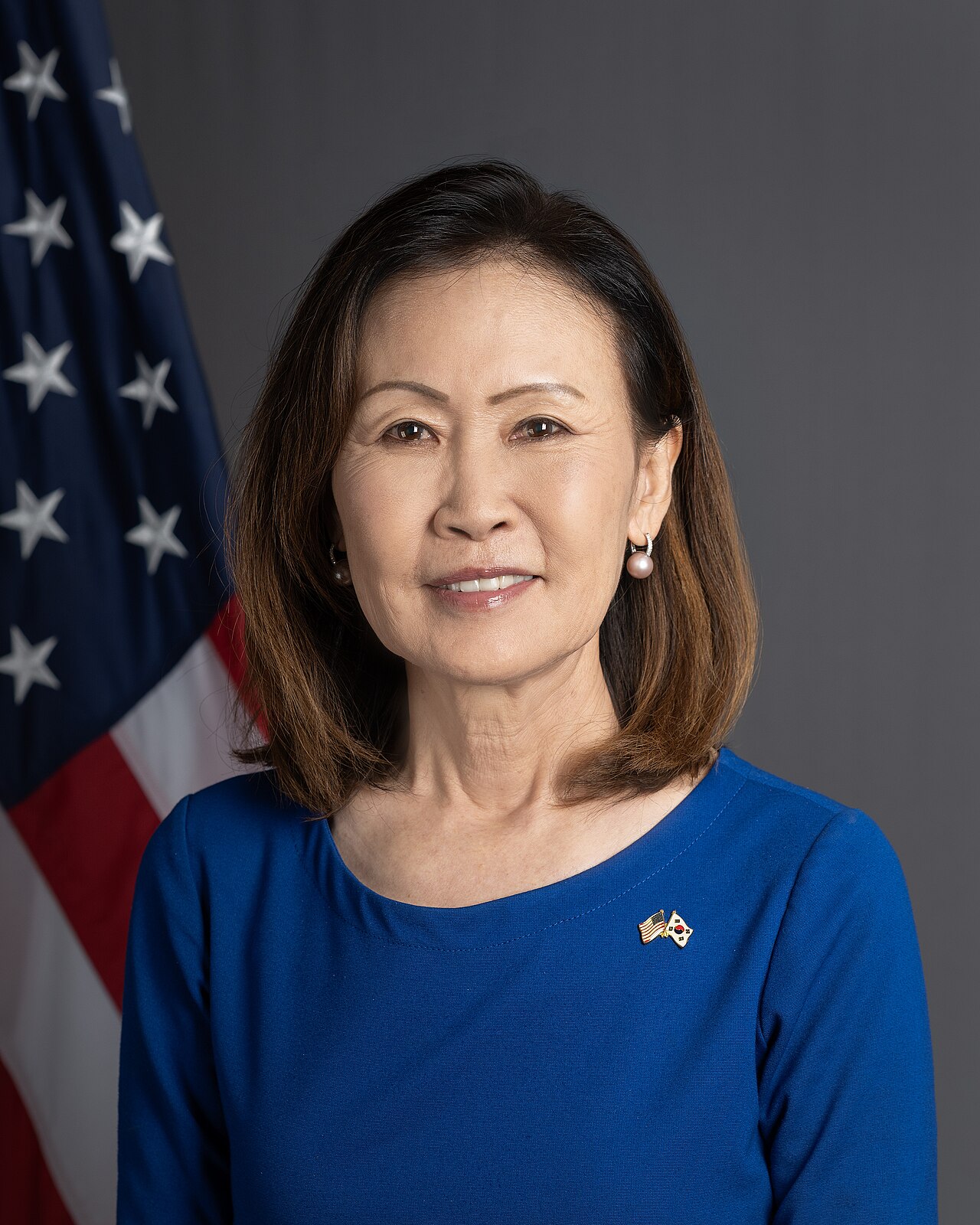
Michelle Steel became US ambassador to South Korea on July 30, 2026, landing at Incheon International Airport and delivering her first remarks in Korean. "I was born in Seoul, but I stand here representing the United States," she said. Steel is the second Korean American to hold the post, after Sung Kim, who served from 2011 to 2014, and the first Korean American woman. The Senate confirmed her on June 17, filling a vacancy that had run roughly a year and a half.
The symbolism is unavoidable and mostly deserved. It is also the least interesting thing about the appointment.
Who is Michelle Steel?
Born in Seoul in 1955, Steel spent part of her childhood in Japan before her family immigrated to the United States in 1975. Her parents were displaced during the Korean War, a detail she has spoken about publicly and which places her squarely inside the generation of Korean Americans whose arrival was shaped by that conflict. She served two terms as a Republican member of Congress from California, from 2021 to 2025, representing Orange County districts with substantial Asian American populations before losing her seat.
Her early public appearances in Seoul have leaned into the biography. She has been photographed downtown, at Gwanghwamun and at a neighborhood Starbucks, in the kind of low key outings that read as a deliberate signal: this is not an outsider being briefed on Korea, this is someone who can order coffee in the language.
What does a diaspora ambassador actually change?
Here is the direct answer, because it is what people search for and what the wire copy skips. In practical terms, a shared background lowers the friction of a posting. Language fluency means fewer interpreters in the room and fewer things lost between them. Cultural legibility means a diplomat is less likely to misread a silence or over read a courtesy. Those are real advantages and they are not small.
What it does not change is the brief. An ambassador represents the sending country's positions, and the positions Steel carries to Seoul are contentious ones. Trade terms, cost sharing for the American military presence, and the broader regional posture toward China are all live and all adversarial in places. A Korean American ambassador arguing an American position is still arguing an American position. The diaspora connection does not soften the ask. In some rooms it may raise the temperature, because a Korean audience can hear a Korean American official's demands as a betrayal in a way it would not hear from a stranger.
The precedent of Sung Kim
Steel is not the first person to run this experiment. Sung Kim, born in Seoul and raised partly in the United States, served as ambassador to South Korea from 2011 to 2014 and later held senior roles on North Korea policy across administrations of both parties. His tenure is instructive precisely because it was unremarkable in the ways that matter. He was a career diplomat, his Korean fluency was an operational asset, and the alliance business proceeded on its own logic.
What Kim's career suggests is that diaspora background functions best as a professional tool rather than a political identity. It got him into rooms and let him read them. It did not make Seoul concede anything it would not otherwise have conceded, and it did not protect him from criticism in the Korean press when American positions were unpopular.
Steel arrives with a different profile. She is a political appointee with an electoral record rather than a Foreign Service career, which is normal for an ambassadorship and which means the relevant comparison is not Kim's technical fluency but her ability to convert a political relationship in Washington into leverage. Ambassadors with direct access to a president are often more useful than ambassadors with deeper regional expertise. Whether she has that access is the thing to watch.
The bind Korean Americans know
That double bind will be familiar to a lot of readers. Diaspora professionals are routinely hired for their proximity to a community and then measured by how well they deliver outcomes that community does not want. It happens in corporate diversity roles, in local politics, in media. Steel is now running the highest profile version of it available.
There is a version of this story that treats her appointment as a straightforward win for Korean American representation, and a version that treats it as cynical casting by an administration with a difficult agenda in Seoul. Both readings are too clean. The honest position is that representation at this altitude is a variable, not a conclusion. It changes how a message is received without changing the message.
What she inherits
The post sat empty for around eighteen months, which is a long time for one of the more consequential embassies in the American network. That vacuum has consequences: working level relationships atrophy, and counterparts learn to route around an embassy that cannot speak with authority. Steel's first task is less about grand strategy and more about rebuilding a channel.
She arrives amid alliance and trade tensions that predate her and will outlast her. Korean officials welcomed the appointment publicly, as they would with any confirmed ambassador after a long gap. The warmth of that welcome will be tested by the first genuinely hard conversation, not by the arrival photos.
There is also a domestic audience she cannot ignore. Korean Americans number well over a million and a half in the United States, concentrated in Los Angeles, the New York metro area, Atlanta, and Northern Virginia, and they follow the Seoul embassy in ways most Americans never follow an embassy anywhere. Visa policy, family reunification, dual citizenship questions for the children of Korean nationals, and consular services are not abstractions to that community, they are logistics. An ambassador who is one of them will be measured on whether those services improve, a metric that never appears in a strategic assessment and matters enormously to the people it touches.
Why this belongs in Asian American coverage
Because the Korean American community has spent decades being told that the path to influence runs through visibility, and this is what the end of that path looks like: a Korean American woman with the title, the language, the family history, and a mandate she did not write. Watching how she navigates it is more instructive than another round of first ever headlines.
Steel is sixteen months into a period where the US relationship with Seoul is being renegotiated in public. Judge the posting on what gets negotiated, not on the fluency of the arrival statement, however good it was.
Sources: The Korea Times; AsAmNews; US Embassy Seoul.