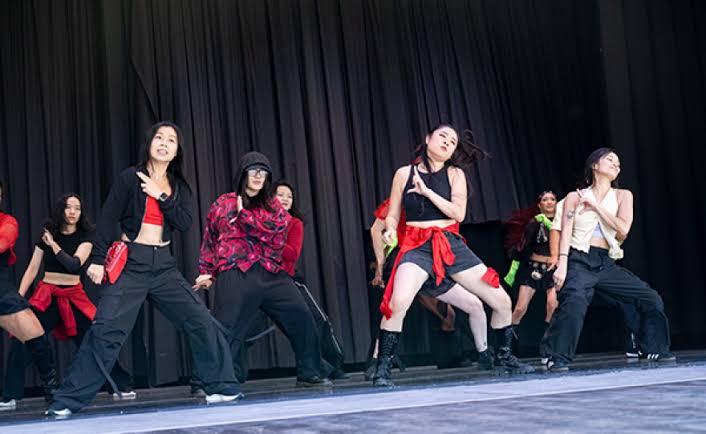
San Diego's second annual Asian American Dance Festival closes this Saturday, October 3, with a free community day at the City Heights Performance Annex and Jeremy Henwood Memorial Park, from 11 a.m. to 8 p.m. It is the last public date of a festival that did not exist before 2025, built by two choreographers who spent most of their careers in dance forms that never asked them to bring their own stories into the studio.
That absence is the reason the festival exists.
What is the Asian American Dance Festival?
The Asian American Dance Festival is a multi-week showcase of Asian American and Pacific Islander dance makers in San Diego, presented by TILTshift Dance and the hip hop collective bkSOUL. The first edition ran in August 2025 and was billed as the region's first multi-day event dedicated specifically to AAPI dance makers. This year's edition opened with a dance film screening at the Museum of Contemporary Art San Diego, followed by a collaborative residency showcase at the Light Box Theater in Liberty Station on September 4 and a mainstage showcase at the Saville Theater at San Diego City College on September 12. Malashock Dance provided studio space for the residency and workshops.
The festival's fiscal sponsor is San Diego Dance Theater, and the City of San Diego's Department of Cultural Affairs provides partial funding. Everything else, as with most arts projects of this size, runs on the organizers' time.
Two careers, one gap
Joyce Lien Kushner runs TILTshift Dance, which she founded in San Francisco in 2015 and moved to San Diego in 2019. She trained for decades in contemporary jazz, ballet and tap. Speaking to KPBS, she described what was missing from all of it: "In none of those dance forms was I ever asked to tell stories of my family lineage or my family's history or immigration story, any of that."
Her co-organizer, grace shinhae jun, teaches dance at UC San Diego and founded bkSOUL in 2001. Between them, the two have spent roughly a quarter century building the regional infrastructure for Asian American dance in San Diego, one company and one class at a time.
Kushner's line gets at something structural about Western dance training. There is plenty of room in it for Asian American bodies. Asian American students are a familiar presence in ballet schools and competition studios. What the training rarely makes room for is an Asian American subject, the family history, the migration, the specific texture of growing up between two sets of expectations. "There wasn't really a space or a place for those of us that identify as being both Asian and American to tell our stories within our dance forms," Kushner told KPBS.
jun framed the festival as a correction aimed at the next generation. "Really thinking about the next generation and filling them with support," she told KPBS, "in the ways that both Joyce and I didn't receive as we were coming up."
What is happening at Saturday's community day?
The community day runs from 11 a.m. to 8 p.m. at 3795 Fairmount Avenue in City Heights and is free. According to TILTshift, festival performances run from 11 a.m. to 3 p.m. and span a remarkable range: tai chi, martial arts, hip hop, breaking, contemporary dance, ballet, lion dance, Chinese classical dance and taiko. Scheduled performers include Matthew Tay, Sifu Ferreira's White Dragon of East County, Fun Sized, CYPHERST8, Jennifer Vieweg, BalletCenter Studios, Xingjian Dance Studio, Shibani Pattanaik with the Center for World Music, Genbu Daiko and Lynch Dance Institute.
This year the community day is paired with a Mid-Autumn Moon Festival celebration, which takes the stage from 3:30 p.m. to 7 p.m. and adds family activities, including mooncake making, lantern making, crafts and a kids' zone. The day ends with a lantern parade led by lion dancers at 7 p.m. There will also be chances for anyone in the crowd to join in the dancing.
The lineup is the argument. A festival that puts breaking and ballet on the same program as lion dance and taiko is saying that all of them are Asian American dance, and that the category is defined by the people doing it rather than by a single tradition.
Why City Heights
City Heights is one of San Diego's most diverse neighborhoods, home to large Southeast Asian, East African and Latino communities, among many others. Holding the free day there rather than at a downtown venue puts the festival where many of the families it wants to reach actually live.
Kushner has pointed to a specific problem the festival is trying to solve. San Diego's Asian American and Pacific Islander communities, she told KPBS, tend to be geographically insular, clustered in different parts of a sprawling county. A festival is one of the few things that puts them in the same room. "Through dance, we move physically in space together," she said. "It provides an opportunity to open up conversations that maybe we won't always have."
What a second year costs
First editions run on adrenaline. Second editions are where arts festivals find out whether they are events or institutions. The Asian American Dance Festival has city arts funding, a fiscal sponsor and a network of partner studios, which is more scaffolding than most first year festivals ever build. It also still leans heavily on two organizers.
That is the story worth following past Saturday. Asian American arts organizations have had a hard two years. In New York, the Asian American Writers' Workshop is now running on volunteers after losing its staff. In San Diego, two dancers are trying to build something that lasts. Whether it does depends on whether the city, its funders and the families who show up in City Heights this weekend treat it as a festival worth keeping.