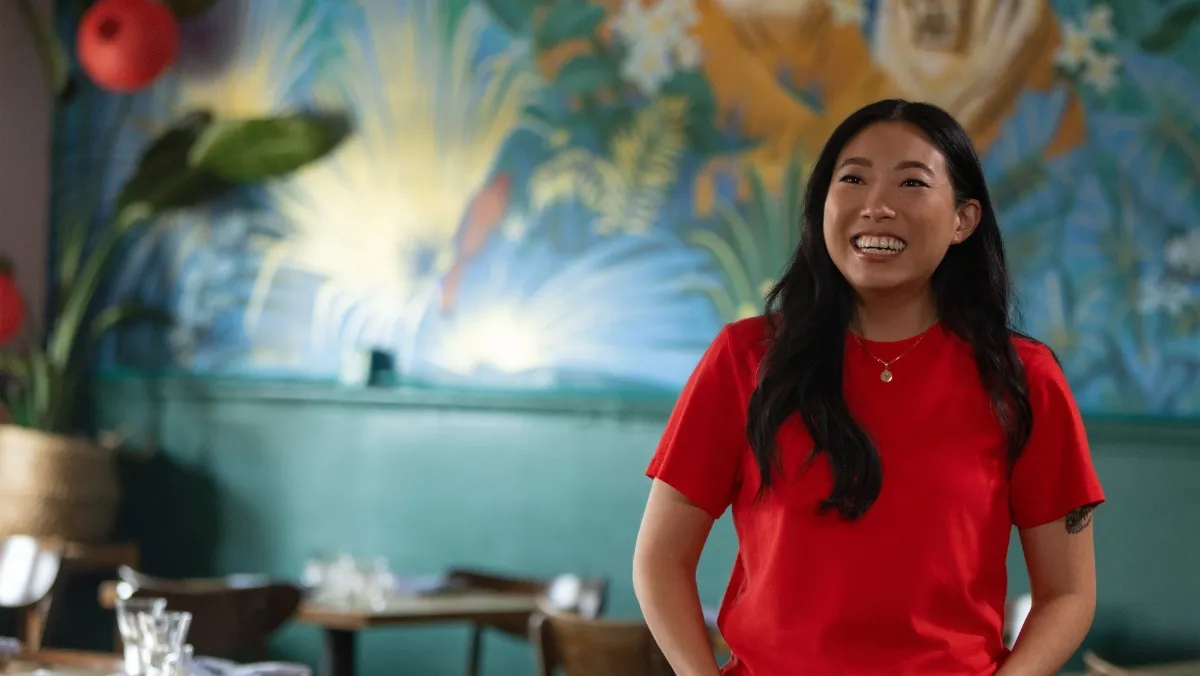
Awkwafina: The Unlikely Cook Premiered on Apple TV Nov. 6

Awkwafina: The Unlikely Cook, an eight-episode docuseries, premiered globally on Apple TV on Friday, Nov. 6, 2026, according to Apple TV Press. The series follows Awkwafina, whose real name is Nora Lum, on a cross-country culinary road trip to revive her family's restaurant, Lum's, which Apple calls "the iconic Cantonese restaurant in Flushing, New York." Here is what Apple and Time Out have printed about it, where their descriptions differ, and what neither says.
This piece sticks to what three pages printed: Apple TV Press's release of Oct. 1, 2026, the series' own Apple TV Press page and a Time Out New York report by Shaye Weaver dated Oct. 3. Where the judgment is ours, we say so, and where the pages are silent, we say that too.
What is Awkwafina: The Unlikely Cook about?
Short answer: a cooking series built around a host who says she cannot cook. Apple's release says Nora Lum inherited the family legacy of Lum's and sets out to build her kitchen skills and, in Apple's words, "explore contemporary Asian American cuisine and reimagine Lum's legacy for a new generation."
The release carries one direct quote, from Lum herself: "I can't cook. Like, at all." Time Out repeats the line and says she jokes it in the trailer. The Time Out report calls her the "amateur chef" and attributes a second line to that chef about the pressure she is under: "Worst case scenario, I throw up, pass out."
Apple's description also gives the series an emotional finish. It builds toward a high-stakes opening night with "the toughest VIP diner of all: her grandma." Time Out brings in the grandmother too, in its account of the Hawai'i stop, which is covered below.
Where does the road trip go?
Both pages list the same stops in nearly the same words. Awkwafina takes a crash course at the Culinary Institute of America. She heads to Texas for barbecue with Jimmy O. Yang. She learns from what both pages call culinary icons Roy Choi and Martin Yan. In Hawai'i she explores the tiki culture that inspired her grandma's restaurant. She also serves at a restaurant in Los Angeles' Chinatown. Apple adds that she meets acclaimed chefs, celebrated restaurateurs and her family, and it names none of them beyond the four people above.
There is one small difference in wording. Apple says she is serving at the Chinatown restaurant, while Time Out says she works as a server there. Neither page names that restaurant, and in the passages we read neither ties a stop to a particular episode.
Who made the series?
Apple's release says the series is produced for Apple TV by Twofour and executive produced by Nora Lum, David Brindley, Itay Reiss and Caroline Davies. It is, in the release's words, the second collaboration between Twofour and Apple TV, following the Emmy Award-nominated travel series The Reluctant Traveler With Eugene Levy. Time Out repeats the Twofour connection and the Levy series, and prints no producer credits of its own.
Time Out also supplies the host's résumé, describing her as a Golden Globe- and Emmy-winning comedian, actress and rapper. That is Time Out's description, not something Apple's release says. The credits Apple prints stop at the producer and the four executive producers.
How do Apple and Time Out frame the series differently?
Apple's release leans on identity and inheritance. It uses the phrase Asian American cuisine, and it describes Lum as someone who inherited a family legacy. Time Out does not use the phrase Asian American at all. It calls Lum's a Cantonese restaurant and tells the story as one of an amateur chef with no culinary skills or kitchen experience trying to revive it.
Neither page states Awkwafina's heritage, or the heritage of Jimmy O. Yang, Roy Choi or Martin Yan, and we do not either. The only cultural labels on the pages are about food: Apple's "Asian American cuisine," and the word Cantonese applied to the restaurant.
What should brands and creators near this series know? Our read
Everything above comes from the pages. What follows is our judgment.
The series gives Asian American cooking a prominent place on a major streaming service, and Apple's own wording about contemporary Asian American cuisine is the hook. For food brands, restaurants and creators who cover Chinese and Cantonese cooking, it is a timely conversation to join, particularly around the stops in Hawai'i, Texas and Los Angeles' Chinatown. A conversation hook is not a shelf, though, and winning attention is a different problem from holding a placement, which is the subject of our earlier look at how Asian American food brands win shelf space and then have to hold it.
The pages name no sponsor, brand partner or product tie-in, so we would not assume one exists. Anyone planning content that uses the show's name or imagery should clear that use with the rights holder first.
What the pages do not say
None of the pages says whether episodes arrived together on Nov. 6 or will release weekly, so check the Apple TV app before you plan content around a particular episode. The pages give no episode titles, no runtime, no reviews and no viewership. They do not say whether Lum's is operating today, or what reviving it means in practice, beyond Apple's line that Nora Lum inherited the family legacy. Neither page names a sponsor.
The Apple release and the Time Out report both predate the premiere, so neither can tell us how the series has been received since Nov. 6. Dates and credits are as printed on the pages when we read them.
For anyone planning around the series, the next step is to open Apple TV, confirm how many episodes are available and read the credits there before building anything on it.