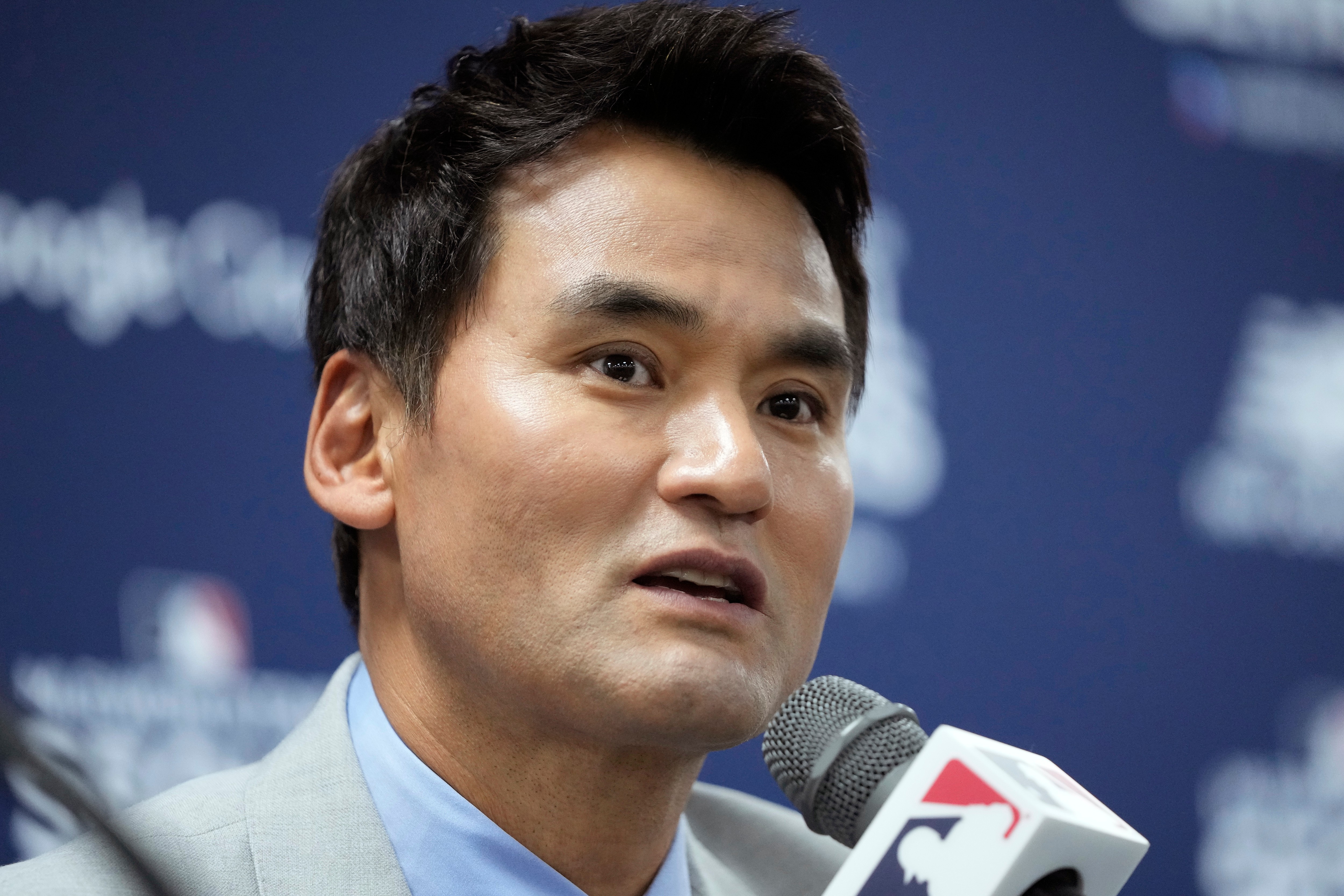
Chan Ho Park's Athletics ownership stake, announced July 27, makes him the first Korean-born person to buy into a Major League Baseball club. He is doing it through Team61, an investment group of roughly thirty people that has committed $55 million to the franchise so far, with another $15 million contingent on league approval. Total announced figure: $70 million.
The names in the group are what made it a headline. Ken Jeong is in it. So is Daniel Dae Kim. So is Suga of BTS.
The names are also why most of the coverage has been wrong about what this is.
What Team61 is buying
Start with the unglamorous part. A $70 million position in an MLB franchise is a minority stake, and minority stakes in professional sports do not come with control. John Fisher remains the Athletics' managing partner. He decides. Team61 does not get to veto a trade, hire a manager, or set a payroll.
What Park gets on top of the equity is a title. He will serve as a senior adviser to Fisher, specifically on player development and Asia strategy. Alongside Park and Suga, the group reportedly includes Samchully Group chairman Lee Man-deuk, Ascend Partners chief executive Hwang In-sun, and Mike Joo, chief operating officer of global investment banking at Bank of America. That is a real capital stack, not a fan club.
And the timing is not incidental. The Athletics are in the middle of relocating to Las Vegas, with the move set for 2028. A franchise in transition needs money and needs a story about who it is going to be when it lands. Team61 supplies both.
Why the ownership side is the story
Asian American visibility in American sports has been almost entirely a story about bodies on the field. Jeremy Lin. Kaitlyn Chen. Alex Eala, who represents the Philippines. Natalie Nakase on a WNBA bench. Each of those is a legitimate milestone and each of them is about performance, which is the only lane the culture has consistently offered.
Ownership is a different asset class entirely. Franchise equity appreciates whether or not anyone plays well. It carries governance rights at the league level once you are inside the room. It is generational wealth that does not depend on a body holding up. The people who own teams shape which markets get franchises, how revenue is shared, and who gets hired to run baseball operations, and none of that is decided by the person leading the league in OPS.
Asian American investors have been almost entirely absent from that room. There are exceptions, and they matter. Kim Pegula co-owned the Buffalo Bills and Sabres. A handful of Asian American investors hold minority pieces of NBA and MLS clubs. But if you list the controlling owners of the 30 MLB franchises, the picture is what you would expect it to be.
So a group of Korean and Korean American investors putting real money into a club, with a named advisory role attached, is a category shift from talent to capital. That is worth reporting carefully rather than as a fun celebrity item.
Be precise about who is Asian American here
This deal gets described as an Asian American ownership story, and that is only partly right. Chan Ho Park is South Korean. He pitched 17 seasons in the majors starting with the Dodgers in 1994, and he is a Korean national. Suga is South Korean. Lee Man-deuk and Hwang In-sun run Korean companies. Team61 is, in structure, a South Korean investment group.
Ken Jeong and Daniel Dae Kim are Korean American. Jeong was born in Detroit and raised in North Carolina. Kim was born in Busan and raised in Pennsylvania from early childhood. Mike Joo is a Korean American banking executive.
Those are different positions with different stakes, and collapsing them into one category is exactly the error 88tumble exists to avoid. What is genuinely interesting is that they are in the same vehicle. Korean capital and Korean American capital investing together in an American sports franchise is a specific arrangement, and it reflects something real about how money and identity move across the Pacific now. Korean conglomerates want American assets. Korean American professionals have accumulated enough capital to co-invest rather than just advise. Neither of those was true in 1994 when Park threw his first big league pitch.
What is still unresolved
MLB has to approve the deal. That is not a formality when the league is simultaneously managing a franchise relocation, and $15 million of the announced $70 million is explicitly contingent on it. Until that clears, the accurate description is that a group has committed capital and is waiting.
The second open question is what "Asia strategy" means in practice. That phrase does an enormous amount of work in press releases and almost never gets defined. It could mean scouting infrastructure in Korea, Japan and Taiwan. It could mean broadcast rights deals. It could mean merchandise and sponsorship in Seoul. It could mean nothing beyond a photo opportunity. The honest answer today is that nobody outside the deal knows, and anyone telling you otherwise is guessing.
The third question is the one nobody in the announcement addressed. The Athletics are leaving Oakland, a city with a deep and long-standing Asian American population, for Las Vegas. Oakland Chinatown is a short walk from the Coliseum side of downtown. Whatever this investment means for Korean baseball fans in Seoul, it arrives attached to a franchise that is abandoning one of the most significant Asian American communities in the country. That tension has gone almost entirely unmentioned, and it should not.
The frame worth keeping
There is a version of this story that runs as "Ken Jeong buys a baseball team," and it will get more clicks than anything written here. It is also the least accurate available summary. Jeong is one of about thirty investors in a minority position, and he is not the person the deal is built around.
The version that holds up is smaller and more useful. A former player who spent his career being introduced as the first Korean to do something is now the first Korean to own something, and he assembled a group that mixes Seoul money with Korean American money to do it. That is what a community looks like when it stops asking to be included in an industry and starts buying pieces of it.
Whether the $15 million clears is the next thing to watch. Whether anyone at the league level notices what the composition of that group signals is the more interesting one.
Related 88tumble coverage: Jeremy Lin on building a pipeline instead of waiting for the next breakout.