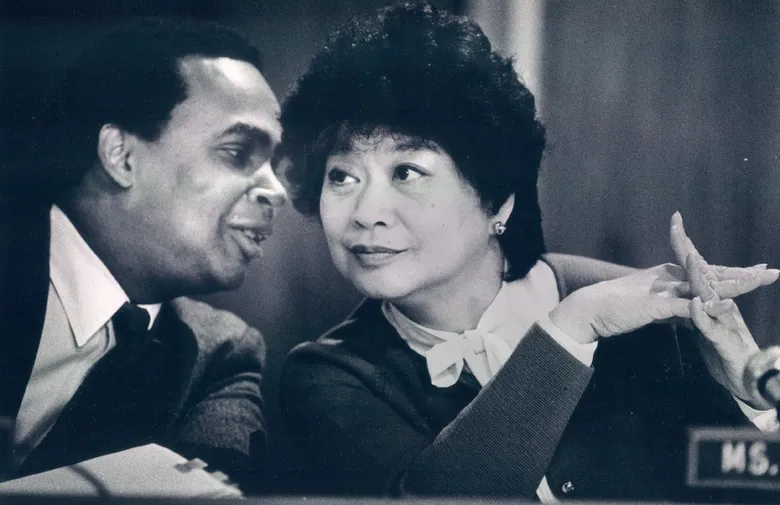
Dolores Sibonga, the first Filipina American lawyer admitted to the Washington State Bar and a pioneering member of the Seattle City Council, died on September 16 at 95. She joined the council in 1978 and served into 1992, becoming, as AsAmNews reported, the first woman of color to sit on it. A month before her death, Mayor Katie Wilson proclaimed August 12, her 95th birthday, Dolores Sibonga Day.
Her death comes as Filipino American History Month begins, and her life is a good place to start it. Sibonga did not just break barriers. She spent decades building the institutions that let others follow.
Who was Dolores Sibonga?
Born Dolores Dasalla Estigoy in 1931, Sibonga grew up in Seattle's Chinatown International District, where her parents ran the Estigoy Cafe, a restaurant and pool hall, according to the North American Post. She earned a journalism degree from the University of Washington in 1952 and worked in television news before going back to school. In 1973 she earned her law degree from UW and became the first Filipina American admitted to the state bar, according to HistoryLink.
She practiced as a public defender and worked with the Washington State Human Rights Commission, AsAmNews reported. With her husband, Martin Sibonga Sr., she also ran the Filipino Forum, a community newspaper that covered and championed civil rights causes in the late 1970s.
Her years on the Seattle City Council
Sibonga was appointed to the council in August 1978 to fill the seat vacated by Phyllis Lamphere, then won election in her own right, according to HistoryLink. She stayed on the council for more than a decade.
Her record reached well beyond any single community. AsAmNews credits her with leading Seattle's first affirmative action ordinance and with championing economic development and the preservation of the Chinatown International District, the neighborhood that raised her. Historian Ron Chew told AsAmNews her impact was "very profound," calling her "a leading voice for economic development."
She also had a streak of independence. She was the lone vote against tax breaks for a new SuperSonics arena, according to her Wikipedia biography.
Redress for Japanese American city workers
One of her most lasting acts came in 1984. Sibonga introduced legislation to compensate five City of Seattle employees who had been fired in 1942 because of their Japanese ancestry. The ordinance passed, awarding each of them $5,000, the North American Post reported.
The amount was modest. The principle was not. It came four years before the federal Civil Liberties Act of 1988 formally apologized for the incarceration of Japanese Americans and paid reparations to survivors. A Filipina American councilmember standing up for Japanese American workers, in a city where both communities had shared the same streets for generations, captured something about Sibonga's politics: solidarity was not a slogan, it was a vote.
The 1989 mayoral race
In 1989 Sibonga ran for mayor of Seattle. She lost, but HistoryLink notes that the campaign brought many Asian Americans together to rally behind her. For a community that had rarely seen one of its own compete for the city's top job, that mobilization was its own kind of result.
After leaving the council, she returned to law, kept writing for the community press and served on state commissions, including a five year term on the Washington State Human Rights Commission beginning in 2000.
"I worked all the time"
Asked late in life about her longevity, Sibonga gave an answer that doubled as a philosophy. "I worked all the time," she said, as quoted by the North American Post. "I'm always interacting with people."
Her daughter, Theresa Escobar, described that same instinct to AsAmNews. "She felt it was important to listen to others," Escobar said, and "to pull people with her, to take them along on the journey."
Wilson called her "a history-making leader in Seattle and Washington state," according to AsAmNews. Her family has said a private celebration of life is planned for the spring.
Why her story matters now
Filipino Americans are one of the largest Asian American communities in the country, and their history in places like Seattle stretches back more than a century, through canneries, farm labor and union organizing. Figures like Sibonga are the bridge between that history and political power, the first generation to take a seat at the table where decisions get made.
She never treated the seat as hers alone. That may be the most useful thing to remember about her this October.