Crafty Ramen Reaches 4,100 US Retail Doors: Target, Kroger

Crafty Ramen, a Canadian restaurant brand that sells frozen ramen bowls, is now available nationally at Target and Kroger, which puts it in about 4,100 U.S. retail doors and nearly 6,400 across North America, according to The Shelby Report on Oct. 22, 2026. A second page, from BriefGlance, carries an Oct. 21 dateline. Here is what the two print about the rollout, where they differ, and what neither says.
This piece sticks to what two pages printed: a Shelby Report staff report from Oct. 22 and a BriefGlance piece by Debra Allen with an Oct. 21 dateline. We did not open the company's own release, so the company's claims reach us only as these two outlets relay them. Where the judgment is ours, we say so, and where the pages are silent, we say that too.
Where is Crafty Ramen sold, and how many doors is that?
Short answer: Target and Kroger nationwide, on top of shelves the brand already had. The Shelby Report lists those existing placements as Sprouts Farmers Market, Schnucks, Meijer, Albertsons and Kings/Balducci's. It puts the brand in about 4,100 U.S. doors and nearly 6,400 North American doors. BriefGlance says "more than 4,100" U.S. grocery doors and "nearly 6,400" North American locations in its text, though its key data box reads "6,400+."
Neither page prints the date the Target and Kroger rollout began. Both describe it as already underway when they ran on Oct. 21 and 22, and that is all we can say about timing.
Who founded Crafty Ramen?
The Shelby Report says Crafty Ramen was founded in Guelph, Ontario, in 2017 by husband-and-wife chefs Jared and Miki Ferrall after training at the Yamato School of Ramen in Japan. BriefGlance gives the same founders, year and training. The Shelby Report says the business began as a 24-seat neighborhood ramen restaurant. Khalil Khamis is named as CEO on both pages.
The Ferralls are quoted too. In paraphrase, they say that their travels in Japan taught them to make ramen the right way and that they have never been willing to cut corners, whether in the restaurant or in the freezer aisle. Neither page describes the founders, the customers or the brand as Asian American, and we make no claim about that. The Japan connection on the pages is the founders' training and the noodle machines, covered next.
What does Crafty Ramen sell, and for how much?
The product is a frozen, layered "puck" of bone broth, scratch-made noodles, protein, vegetables and toppings, prepared in minutes on the stovetop or in a microwave-safe bowl. Both pages give a suggested retail price of $7.99 per bowl. There are five varieties, inspired by dishes at the company's restaurants: Spicy Chicken Tantanmen, which The Shelby Report calls the No. 1 seller, plus Brisket Birria, Chicken Shoyu, Spicy Pork Miso and Shiitake Pork Shoyu.
As The Shelby Report relays it, the company positions the line as a restaurant-inspired alternative to traditional instant ramen. The same page says the noodles are produced in-house daily on Japanese noodle machines at the company's own Ontario facilities, and it does not name a city.
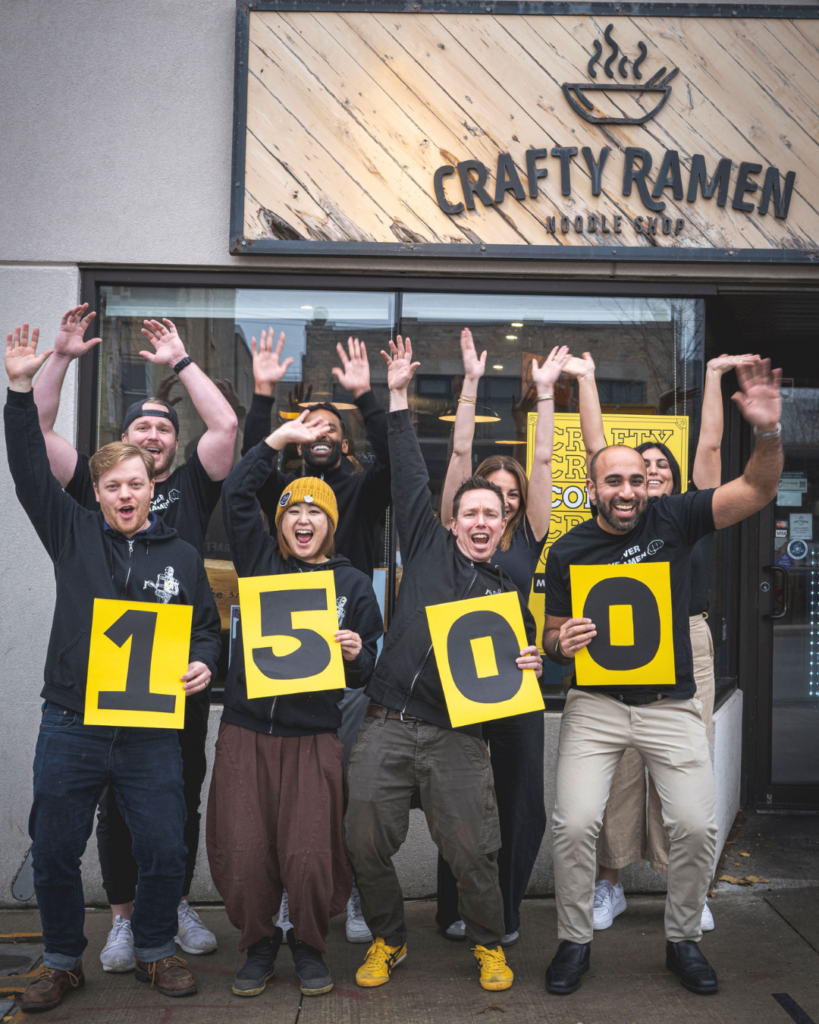
How did Crafty Ramen go from about 150 doors to 6,400?
That is the CEO's framing, not an independent count. Both pages quote Khamis: "Crafty Ramen has experienced rapid retail growth, expanding from approximately 150 doors to 6,400 in just four years." He adds that the company has sold more than 2 million bowls to date and has scaled production capacity from 2,500 to more than 55,000 bowls per week. Neither page gives a time frame for the capacity figures, and neither says whether the 150 starting doors were all in Canada.
Where do the two pages differ?
Mostly in small ways. The Shelby Report says "about 4,100" U.S. doors, where BriefGlance says "more than 4,100." BriefGlance says "nearly 6,400" North American doors in its text but "6,400+" in its key data box. The larger difference is the 2 million bowls. The Shelby Report gives the figure as "to date." BriefGlance places it before the U.S. push and in Canada, which is the publication's own wording and not the CEO's. We use The Shelby Report's wording.
BriefGlance also adds details that appear on no other page we read, including a plant location, cold chain partners and a pandemic meal kit history. We left those out because we could not confirm them. The company quotes on the two pages also match closely in places, which points to a shared company source, though neither page says so. That is our inference.
What can food brands take from this? Our read
Everything above comes from the pages. What follows is our judgment.
The headline number is bigger than it looks and smaller than it sounds. About 4,100 of nearly 6,400 doors are in the U.S., which is about two thirds. That is our arithmetic from The Shelby Report's figures, and it means roughly a third of the footprint sits outside the U.S. market the Target and Kroger news is about.
For overseas and restaurant-born brands weighing U.S. grocery, the open question is sequencing. Both pages describe a brand that already had Sprouts, Schnucks, Meijer, Albertsons and Kings/Balducci's, and then added Target and Kroger. Neither says in what order, on what terms or with what promotion, so we would not treat a launch across two national chains as a template. A brand weighing the same move should ask buyers which freezer sets are being reset, what sales per door a chain expects, and what happens to a placement that misses the mark. That last question is the subject of our earlier piece on how Asian American food brands win shelf space and then have to hold it. Neither page calls Crafty Ramen Asian American. We link it for the shelf-space problem, not for the brand.
Capacity is the other number worth holding up. The CEO's 55,000 bowls a week, set against nearly 6,400 doors, works out to about 8.6 bowls per door per week if every bowl went to retail. That is our arithmetic, it treats capacity as if it were sales, and the pages do not say how production is split between retail and the company's restaurants. Read it as a sense of scale, not a sales rate.
What the sources do not say
Neither page prints the date the Target and Kroger rollout began, a market size for frozen ramen, or a time frame for the capacity figures. Neither says how many Target or Kroger stores carry the line, how the doors divide across retailers, what the company paid for placement, or what sales per door look like. Neither page prints sales results for the new placements, so we cannot say how the line is selling.
The rollout rests on one trade report and one secondary page, and we did not open the company's own release. Neither page mentions Asian American founders, shoppers or communities, so we make no claim about that audience. For brands, the practical next step is to ask Target and Kroger buyers directly which freezer sets are open, and to confirm every door count with the company before repeating it.