Korean Beauty ODMs Win Private Label Deals From Retailers

Korean beauty ODMs are landing private label work from overseas retailers and drugmakers, according to a Nov. 15 report by Kang Dong-heon in Seoul Economic Daily. The report names Kruidvat, Mercadona, Rossmann and Ulta Beauty as chains that now sell Korean-made skincare under their own store brands, and it says three of Korea's biggest contract manufacturers have grown export revenue sharply since 2022.
Every figure in this story comes from that one report, which the paper's English edition labels as AI translated from Korean. 88tumble has not confirmed any of it against company filings, so the numbers are the newspaper's, not ours. For a U.S. brand or retailer deciding who makes its next line, the useful parts are the lead times, the capacity spending and the gaps, all covered below.
What is a Korean beauty ODM, and why do private label buyers use one?
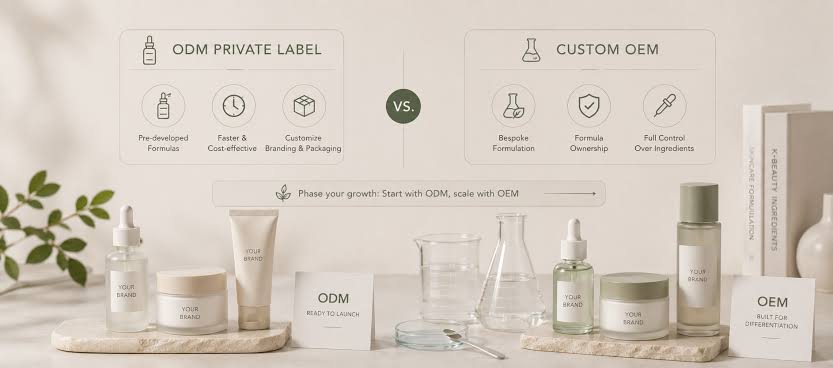
ODM stands for original development and manufacturing. An ODM develops and produces a product that another company sells under its own name. For a retailer, that is the private label route: the store brand on the box, a specialist manufacturer behind it.
The report's argument is that the customer list for Korean ODMs has widened. It used to be K-beauty brands expanding abroad. Now, it says, overseas retailers and drugmakers are commissioning products too, and foreign chains are treating a "Made in Korea" label as a competitive asset of their own.
Which retailers are putting Korean-made skincare under their own labels?
The report lists four chains, and the details differ by retailer.
- Kruidvat: launched eight Korean-made products as Kruidvat Korean Skincare in June, according to beauty industry sources cited by the paper. The chain runs more than 1,250 stores in the Netherlands and Belgium and already sold K-beauty brands including Beauty of Joseon and SKIN1004.
- Mercadona: which the report calls Spain's largest supermarket chain, released Korean-made PDRN and collagen eye patches in August under its Deliplus brand, then added a K-Skin line last month with a PDRN serum and a gel cream.
- Rossmann: the German drugstore chain introduced eight skincare products developed and made in Korea in October of last year under its ISANA label.
- Ulta Beauty: sells Korean-made eye patches starting at $8 under the Ulta Beauty Collection brand.
Ulta is the only U.S. retailer in the report, and the paper gives no launch date for it. The report also does not name the manufacturer behind any of the four retail lines.
Which drugmakers are working with Korean manufacturers?
Two deals sit outside retail. Genecell, the Korean unit of Japanese drug distributor Alfresa Group, signed a September contract with Cosmax to develop and produce premium cosmetics using stem cell culture supernatant. Brazil's Cimed is investing 80 million reais, about 18.9 billion won by the report's conversion, with Korea's GDK Cosmetics on a skincare brand called Mili. Seven products have been developed and produced so far, and the plan is to reach 100 by the end of next year.
How fast are the big Korean ODMs growing?
The report gives export revenue for three manufacturers, comparing last year with 2022, in Korean won.
- Cosmax: 450.5 billion won, up from 263.6 billion.
- Kolmar Korea: 90.6 billion won, up from 41.9 billion.
- Cosmecca Korea: 73 billion won, up from 28.9 billion.
By 88tumble's arithmetic, that is growth of about 71 percent at Cosmax, about 116 percent at Kolmar Korea and about 153 percent at Cosmecca Korea. The report ties the rise to the broader customer base but does not say how much of it is private label work, so these are overall export totals.
The makers are also adding room. Cosmecca Korea is investing a total of 200 billion won in a new production base in Ochang, North Chungcheong Province. Cosmax is spending 60.5 billion won to expand its plant in Pyeongtaek, Gyeonggi Province. Kolmar Korea's Sejong plant is expected to come online next year.
What does the analyst in the report say about speed and capacity?
Kim Myoung-joo, an analyst at Korea Investment & Securities, is the report's source on two points. Kolmar Korea's Sejong plant should let it absorb at least 30 percent revenue growth over the next three years. And Cosmax takes three to four months to develop and produce a product, against five to eight months for global rivals, an edge in a market where speed to launch matters.
Both are one analyst's claims, passed through a translation, and the report does not show the data behind them.
What should a U.S. beauty brand check before choosing a Korean ODM?
This section is 88tumble's reading, not the report's. For a U.S. beauty or personal care brand weighing a Korean manufacturer for a private label or a new line, the report is a lead, not proof. Four checks follow from what it says and what it leaves out.
- Lead time: the three to four month figure is one analyst's comparison. Ask any ODM for its own schedule in writing.
- Capacity: the expansions are announced spending, and the Sejong plant is not online yet. More retail customers also means more buyers in line for the same factories, though the report does not say capacity is tight. Ask when your line would actually run.
- Proof in the U.S.: the lone American example is Ulta's eye patches from $8, with no date and no named maker. Ask for U.S. launches you can verify.
- The numbers: confirm export revenue against company disclosures before you quote it.
For how Korean skincare brands are selling in the U.S. today, see our coverage of medicube on TikTok Shop and Goodal at Costco.
What do we still not know about this report?
A lot sits outside the page. Apart from Genecell with Cosmax and Cimed with GDK Cosmetics, the report does not pair any buyer with a manufacturer. It gives no sales figures for the Kruidvat, Mercadona, Rossmann or Ulta lines, and no share of ODM revenue that comes from private label. And the whole piece is a machine translation of a Korean original, which the English page links as the Korean version. Before you plan around any of these numbers, read that original and check them against company statements.