Ozawa v. United States and United States v. Thind were decided three months apart in the winter of 1922 and 1923. Both asked whether an Asian immigrant could become an American citizen. Both said no. The Supreme Court reached that answer twice using reasoning that directly contradicted itself, and the same justice wrote both opinions.
Most people have never heard of either case. They are the foundation of a century of Asian American legal status, and the logic inside them has never really been retired.
What the Ozawa case decided
Takao Ozawa arrived in San Francisco in 1894. He graduated from Berkeley High School, attended the University of California, moved to Hawaii, worked for an American company, raised his children in English, sent them to American schools and attended a Christian church. He did not petition for citizenship on the theory that he had assimilated. He petitioned because the naturalization statute limited citizenship to "free white persons" and persons of African descent, and he argued, in effect, that his skin was light and his life was American.
The Court ruled against him on November 13, 1922. Justice George Sutherland wrote the opinion. Ozawa, he held, was not Caucasian, and "white person" meant Caucasian. The scientific race categories of the era did not include Japanese people among Caucasians, so the question was settled.
Sutherland went out of his way to say the ruling implied no disrespect. The Court, he wrote, was not passing judgment on Ozawa's character. It was simply applying a definition. That framing, that exclusion is neutral administration rather than hostility, is worth holding onto. It reappears constantly.
What the Thind case decided three months later
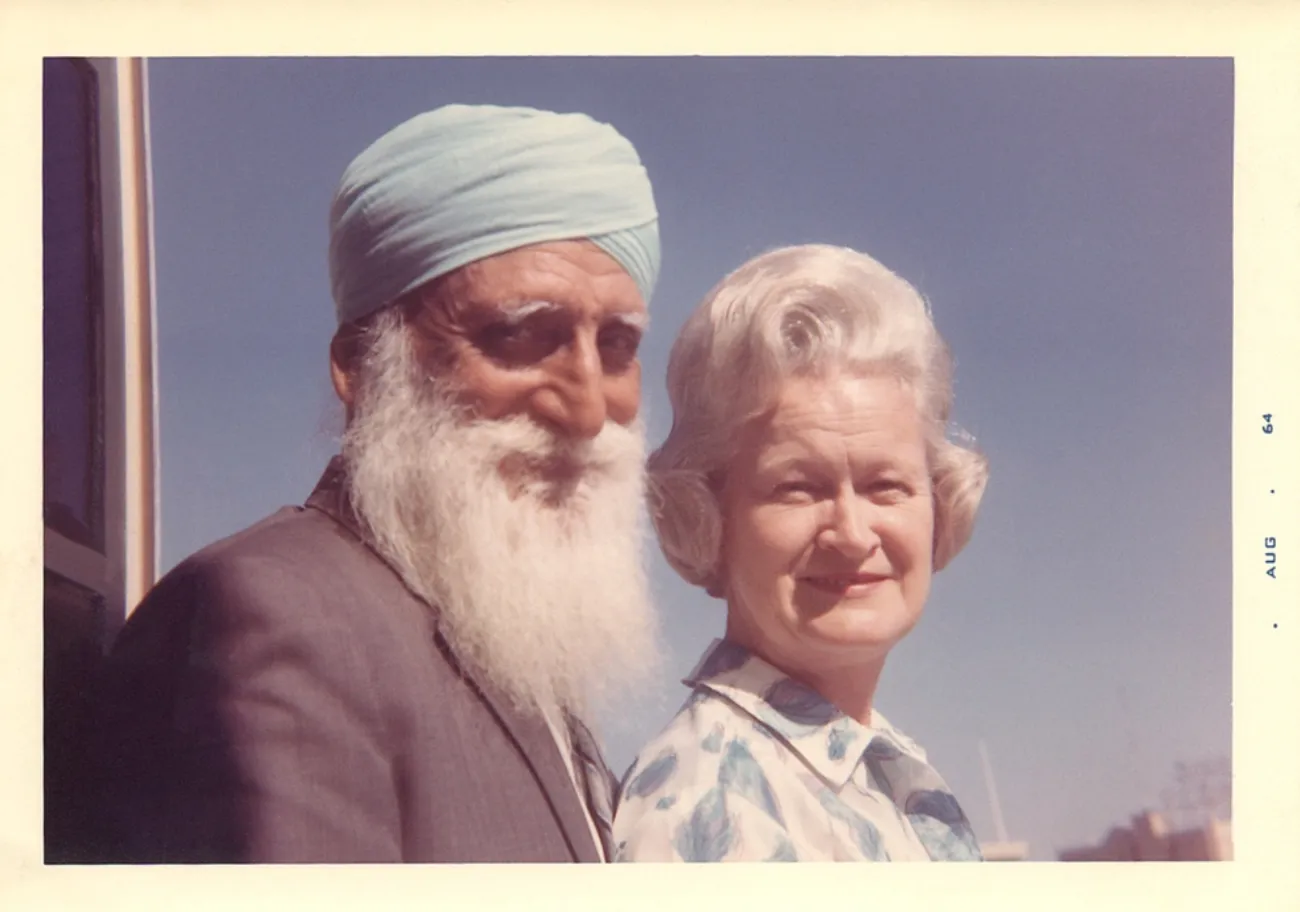
Bhagat Singh Thind was a Sikh man from Punjab who came to the United States in 1913, worked in Oregon lumber mills, studied at Berkeley, and enlisted in the U.S. Army during the First World War. He served, was honorably discharged, and applied for citizenship.
Thind's lawyers made the argument Ozawa's had failed to make. They used the Court's own standard. Anthropologists of that period classified North Indians as Aryan and therefore Caucasian. If "white person" meant Caucasian, as Sutherland had just written, Thind qualified on the Court's own terms.
On February 19, 1923, Sutherland ruled against him anyway. And he did it by abandoning the test he had established twelve weeks earlier. Scientific classification, he now wrote, was not what Congress meant. The statute should be read according to "the understanding of the common man." Whatever an ethnologist might say, ordinary Americans did not regard a Punjabi Sikh as white. Case closed.
So in November the standard was science, and Ozawa lost because science excluded him. In February the standard was popular perception, and Thind lost because science included him. The test changed to guarantee the outcome.
What happened to the men afterward
This is the part that gets left out of the summary.
After Thind, the government did not simply stop granting citizenship to South Asians. It went back and stripped it from people who already had it. Roughly fifty South Asian Americans were denaturalized in the years that followed. Some had been citizens for over a decade. Among them was Vaishno Das Bagai, a San Francisco businessman who had come to the United States in 1915, opened a general store on Fillmore Street, and become a citizen in 1921. His citizenship was revoked. Because California's alien land laws barred non-citizens from owning property, he lost his business too, and he could not obtain a passport to visit India because he was no longer American and no longer legally Indian either.
In 1928 Bagai rented a room in San Jose, turned on the gas, and killed himself. He left a letter to the San Francisco Examiner. "I came to America thinking, dreaming and hoping to make this land my home," he wrote. He described himself as barred from every path and asked what other course was left to him.
Thind himself eventually became a citizen in 1936, through New York State, under a law granting naturalization to veterans of the First World War. He earned a doctorate and spent his life lecturing on spirituality. Ozawa stayed in Hawaii and never naturalized. He died in 1936.
What the rulings unlocked
The cases were not abstract. They were the legal key that made a much larger apparatus function.
California's Alien Land Law of 1913, strengthened in 1920, barred "aliens ineligible for citizenship" from owning agricultural land. Washington, Oregon, Arizona, Texas and roughly a dozen other states passed versions of the same thing. The statutes never named a race. They did not have to. They pointed at naturalization eligibility, and Ozawa and Thind were what filled that phrase with meaning.
Japanese American farming families, who by the 1920s were producing a substantial share of California's vegetables and cut flowers, responded by putting deeds in the names of their American-born children, who were citizens by birth. Prosecutors went after that too, filing escheat actions to seize land held in trust for minors. Families spent the next twenty years farming property they could lose in court at any time, which is part of why so little was recoverable when the same families were forced into camps after 1942 and returned to find their holdings gone.
The Cable Act of 1922, passed a month before Ozawa was decided, stripped American women of their citizenship if they married an alien ineligible for naturalization. An American-born woman who married a Japanese or Indian immigrant became stateless in her own country. Congress did not repeal that provision until 1931.
Two short opinions about two men, and this is what they carried.
Why these cases are back in circulation
An op-ed published by AsAmNews on August 7 pulled Ozawa and Thind forward to make a point about hate crime data, and the connection is sharper than it first sounds.
Roughly 18,000 law enforcement agencies participate in the FBI's national hate crime reporting system. Participation is voluntary. Each agency applies its own judgment about what qualifies as bias-motivated and whether to report it upward. The result is a federal dataset assembled from thousands of local discretionary calls, which produces numbers that look authoritative and measure something closer to institutional willingness than to lived experience.
Set that against Stop AAPI Hate's survey work, which found this year that 49 percent of AAPI adults said they experienced a hate act in 2025, the third consecutive year near that figure. One number counts what agencies chose to classify and report. The other counts what people said happened to them. The gap between them is not a measurement error. It is a question about who gets to define the category.
Which is exactly what Sutherland was doing. The definition of "white person" was never a fixed fact being discovered. It was a boundary being drawn, adjusted whenever it produced an inconvenient result, and presented each time as neutral application of an existing rule.
What this history does not mean
A century is a long time and the comparison should not be stretched past what it holds. Ozawa and Thind were about statutory racial bars on naturalization, and those bars are gone. The Immigration and Nationality Act of 1952 eliminated race as a criterion. The 1965 Act dismantled the national origins quota system. A Japanese or Indian immigrant today faces a process with real problems, but not that one.
Anyone arguing that nothing has changed is not being careful. Fifty denaturalizations, a suicide letter to a newspaper, and a Supreme Court that reversed its own reasoning inside of three months are not the same as a flawed voluntary reporting system, and treating them as equivalent cheapens the first thing rather than illuminating the second.
The useful continuity is narrower and harder to dismiss. It is that the machinery for deciding who belongs has consistently been discretionary, consistently been described as neutral by the people operating it, and consistently produced the answer the operators preferred. Sutherland switched from science to common understanding. A police department decides an assault was a robbery rather than a bias crime. Neither one announces itself as a choice.
Why you should read the opinions
Both are short. Ozawa runs a handful of pages. Thind is shorter. They are freely available and they read very differently from how they get summarized, because Sutherland's prose is calm, reasonable, and entirely certain of itself. That tone is the most instructive thing about them.
These cases are taught in Asian American studies programs and almost nowhere else, which is why a hundred years later they still function as specialist knowledge rather than as American history. They belong in the second category. They explain why Japanese American families could not own the land they farmed before internment, why South Asian American communities in California lost property in the 1920s, and why the legal status of Asian Americans has so often been provisional in ways that are difficult to see until something removes it.
Takao Ozawa spent twenty years proving he was American and was told the question was about race, not conduct. Bhagat Singh Thind met the racial test the Court had just written and was told the test had changed. Both men were right about the law. That was never what the law was for.
Related 88tumble coverage: the impact of 9/11 on Asian Americans.