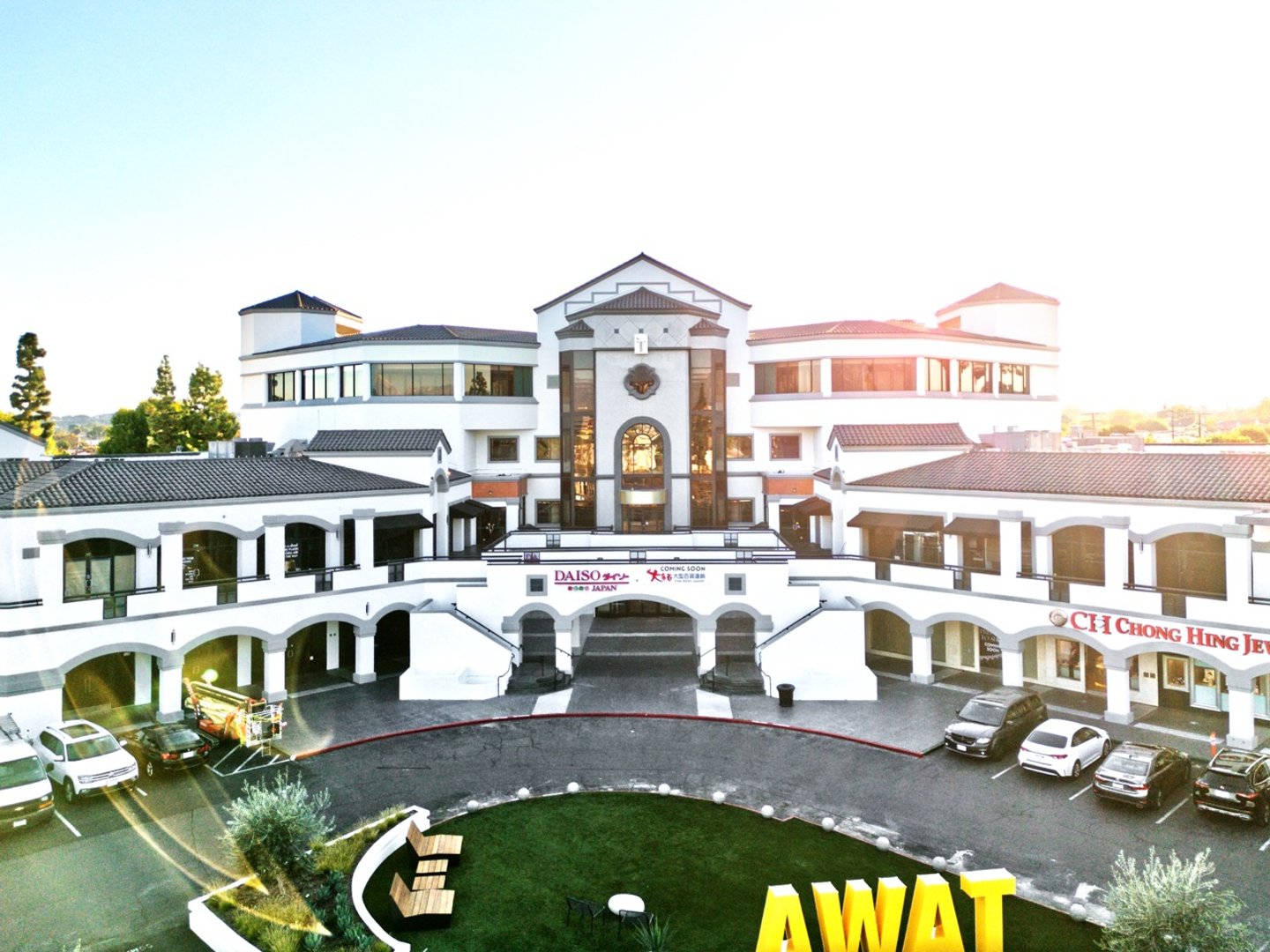
TAWA Gateway sits at Valley Boulevard and Del Mar Avenue in San Gabriel, roughly twelve acres anchored by a 99 Ranch Market, drawing close to three million visitors a year. Since February it has added Guiji Tea, Dong Ting Chun, Cha Redefine, Bafang Dumpling, Happy Lamb, Bingz Crispy Burger and Show Hot Pot. A Vietnamese com tam specialist is slated for 2027. Several of those are first US locations.
That is eight food tenants in seven months at a single intersection. The San Gabriel Valley has been the most important Asian food geography in the country for forty years, and it is being reorganized right now by a landlord.
What is actually opening at TAWA Gateway
The development is run by Sunny Skies Terrace, which announced in late June that it had completed phase one of a multi-year redevelopment. Fourteen new tenants are scheduled to come online through early 2027, and phase two is expected to be announced this fall.
The food lineup, by opening date: Guiji Tea in February, its first US location. Dong Ting Chun in March, a new flagship. Cha Redefine in May. Bafang Dumpling in June, a Taiwanese chain with more than 1,100 locations across Taiwan, Hong Kong and mainland China. Happy Lamb in July, Mongolian-style hot pot with more than 100 locations. Bingz Crispy Burger in July, one of the first US outposts of a chain that grew large in China and Canada. Show Hot Pot in August. Com tam Sa Bi Chuong is scheduled for March 2027.
Retail is filling in alongside it. The Best Shop opened its first US location in late June. Miniso arrived in July. Golf Envy is slated for September, Kawaii Klaws for January, an escape room for March.
Two things jump out of that list. Almost every food tenant is a chain, and almost every chain is an import making its American debut or near-debut.
What a landlord-built food hall does to a food scene
The San Gabriel Valley's reputation was not built this way. It was built by independent operators in tired strip malls with bad parking and no signage in English, by families who opened a Chongqing noodle shop or a Shanghainese soup dumpling counter because that was the food they knew and the rent was survivable. Sichuan Impression, Chengdu Taste, Newport Seafood, Pearl River Deli. The valley became a destination because individual people took individual risks over decades, and because commercial rent in Alhambra and San Gabriel and Rowland Heights was low enough that being wrong did not end you.
A curated, professionally leased, twelve-acre center with a national retail broker is a different mechanism producing a similar-looking result. The food may well be good. Bafang and Happy Lamb are large chains because they are competent. But the selection logic has changed from what a family wanted to cook to what a leasing team believes will produce reliable traffic across a portfolio.
The immediate consequence is rent. A successful anchor development raises the comparable rents for every other property nearby, and the independents who built the neighborhood's reputation are the tenants least able to absorb that. This is not speculation about TAWA specifically. It is how commercial real estate works everywhere, and the SGV has already been watching it happen along the redeveloped stretches of Valley Boulevard.
The case for it
There is a real argument on the other side, and it deserves better than a strawman.
Asian American communities have historically been tenants rather than owners of the commercial spaces they made valuable. When a neighborhood becomes a destination, the appreciation usually flows to a landlord who has nothing to do with the community, and the businesses that generated it get priced out of their own success story. Chinatown in Los Angeles is the standing example, and Manhattan's is another.
TAWA Gateway is different in one respect that matters. The center takes its name from Tawa, the company behind 99 Ranch Market, a chain founded by Roger Chen in 1984 in Southern California that grew into the largest Asian supermarket operator in the country. The capital deciding what the SGV becomes is, at least in part, capital that came from inside the community rather than from a private equity fund in Dallas.
That is not a small distinction. It is also not a guarantee of anything. A landlord with the right last name still charges market rent.
What to watch
Three things worth tracking as phase two is announced this fall.
First, whether any independent operator gets a space. Fourteen tenants and the announced list is almost entirely chains. If phase two is the same, that tells you the leasing model, and it will not change afterward.
Second, what happens to rents in the surrounding blocks over the next 24 months. Valley Boulevard between Del Mar and New Avenue is dense with exactly the kind of small operator that made the corridor matter. If those storefronts start turning over, the reason will be visible in the lease comps.
Third, whether the food is actually good. This piece is about structure, but nobody in the SGV cares about structure at dinnertime. A chain that arrives with 1,100 locations behind it can be excellent, and Bafang has a real reputation in Taipei. It can also be a competent version of something a family two miles away does better for less. Both outcomes are common and only one of them justifies the parking.
The honest read
The San Gabriel Valley is not being gentrified in the usual sense. Nobody is displacing Chinese American restaurants with a wine bar. It is being consolidated, which is a quieter process and arguably a more durable one. Independent operators are being joined, and over time possibly replaced, by professionally capitalized chains inside professionally managed centers, and the capital doing it is Asian American.
That is a more complicated story than either available cliche. It is not a hidden gem roundup and it is not a gentrification obituary. It is the San Gabriel Valley growing up into an institutional real estate market, with all the reliability and all the flattening that implies.
Go eat at Show Hot Pot. Then go eat somewhere on Valley Boulevard that has been there fifteen years, and pay attention to which one is still open in 2030.