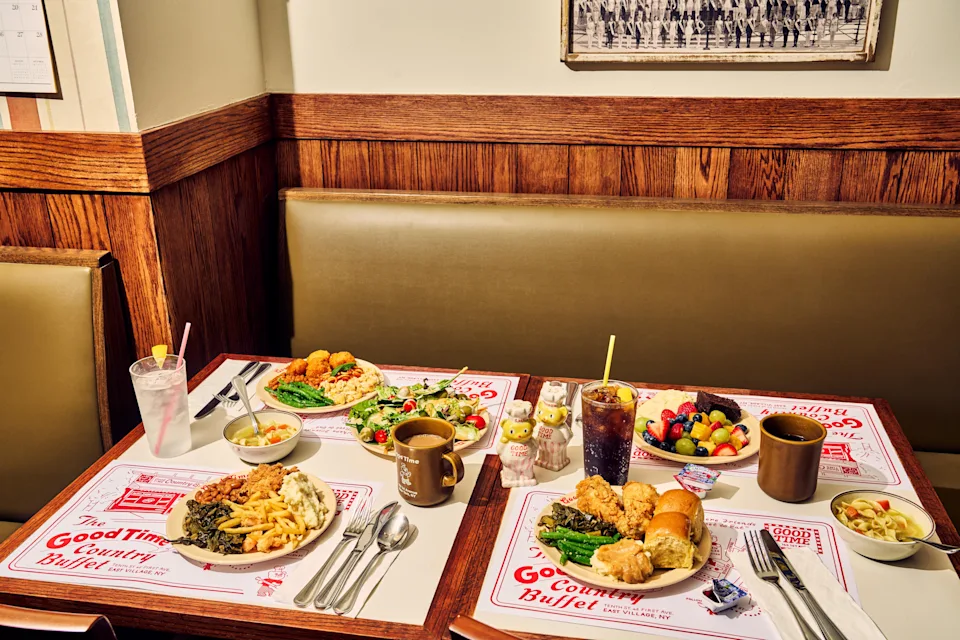
Good Time Country Buffet opened on September 12 at 166 First Avenue in the East Village, and it serves exactly what the name promises: fried chicken, cornbread, Salisbury steak, mac and cheese, collard greens, banana pudding and peach cobbler, all you can eat. What it does not serve is a Korean version of any of it. That choice is the most interesting thing about the restaurant, because the people behind it are David Yun, Steve Choi and Yong Min Kim, the Korean American team that built C as in Charlie and Kisa into two of the more talked about restaurants in downtown Manhattan.
For them, the Southern buffet is not a genre to remix. It is a memory to get right.
Who is behind Good Time Country Buffet?
Yun, Choi and Kim opened C as in Charlie on Bleecker Street in 2022, a Korean and Southern restaurant that earned a Michelin Bib Gourmand. In 2024 they opened Kisa on Allen Street, modeled on the kisa sikdang, the no frills diners in Korea where taxi and bus drivers stop for a fast, filling meal. Yun has described Kisa as a way to "showcase our roots, heritage, and aspects of our upbringing that we missed while living in the U.S."
Good Time Country Buffet is the third restaurant, and it tells a different part of the same story. The broker who handled the lease, Bobby Ortense, told Commercial Observer that each of the group's locations "tells a different part of their story growing up in the South as Korean American immigrants."
The Korean immigrant story inside the country buffet
Yun's connection to the country buffet is not theoretical. He told Eater that as a kid he "hopped on [my father's] truck to deliver boxes of cabbages to those country buffets." In high school, he worked the register at a buffet owned by a friend's father.
That detail opens up a history most food coverage skips. Korean immigrant families built much of their economic footing in the United States through small businesses that demanded long hours and little start up capital: dry cleaners, grocery and convenience stores, beauty supply shops, wholesale produce. In Yun's telling, the country buffet sat inside that world too. His father's truck supplied them, and as a teenager he worked the register at one.
The food was not Korean. For families like Yun's, the work behind it was.
Seen that way, Good Time Country Buffet is not an Asian American restaurant making Southern food. It is a Southern restaurant the owners grew up inside, finally opened under their own name in Manhattan. "It's not something we're inventing," Yun told Resy. "We're just reintroducing it."
What is on the buffet, and what does it cost?
The spread is classic. Hell Gate's early visit counted fried chicken, Salisbury steak, meatloaf, mashed potatoes, collard greens, braised cabbage, corn salad, baked beans, mac and cheese, fried shrimp, Buffalo wings, hush puppies and dinner rolls, with banana pudding, peach cobbler and hot fudge on the dessert end. Rotating dishes include catfish and chicken wings, and there is a salad bar.
Dinner runs about $27 a person, with discounts for seniors and children, according to reports from the opening. Takeout is sold by the container. As always with a new restaurant, check current prices before you go, because they tend to move in the first few months.
Choi's pitch for the experience is simplicity. He told the New York Post he wants people to "come in without thinking about what to get," to "just walk in and not be shocked."
Why the buffet disappeared, and why it is coming back
The all you can eat buffet took a beating during the pandemic. Self serve lines and shared utensils collided with public health rules, and many mom and pop buffets closed for good, a trend the New York Post noted in its coverage of the opening.
Its return now is partly a price story. Restaurant prices have climbed since 2020, and a flat price for as much food as you can eat has become a rare kind of value in New York. The buffet's comeback also taps a nostalgia that cuts across backgrounds. For a lot of Americans, Asian American or not, the country buffet was the family dinner out: after church, after a game, on a birthday.
The authenticity argument, turned around
Asian American chefs are routinely asked whether their food is authentic, a question that usually means whether it matches an outsider's idea of the cuisine their family came from. Good Time Country Buffet flips it. The owners are not claiming Southern food as fusion or reinvention. They are claiming it as their own childhood, cooked straight, the way it was served in the buffets Yun's father supplied and where Yun once worked the register.
That is a more confident position than fusion. It says Korean American history can include the Southern buffet, and that nobody needs to add gochujang to prove it. In the same year that a Chinatown wine bar won Best New Restaurant in America, it is another sign that New York's Asian American restaurateurs are done asking permission about what counts as their food.