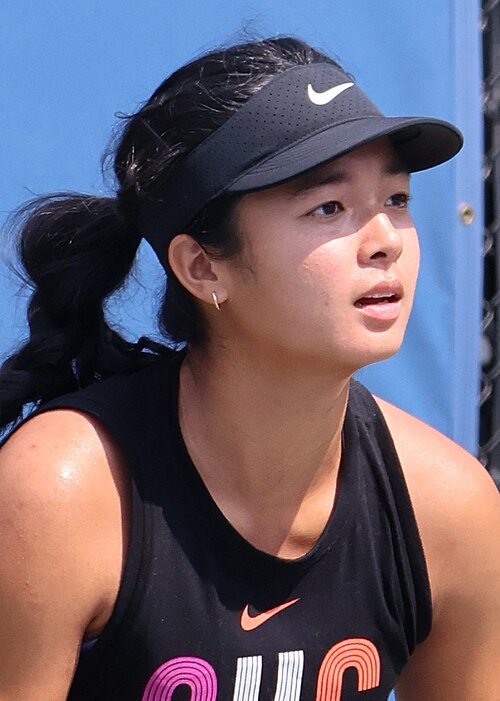
Alex Eala won the 2026 Mubadala DC Open on August 3, beating top seed Jessica Pegula 4-6, 6-4, 6-0 after an overnight rain suspension. It is the first WTA Tour singles title ever won by a Filipino player. Eala represents the Philippines, not the United States, and the reason this belongs in Asian American coverage is standing in the stands: the Filipino American contingent that filled a Washington hard court and turned a final against an American into an away match for the American.
What happened in the final
Pegula took the first set. Rain suspended play overnight, which in tennis is a coin flip that can settle a nervous player or unsettle a confident one. Eala came back the next day, took the second, and then did not lose a game in the third. A 6-0 set against a top ranked opponent in a final is not a comeback so much as a takeover.
"To all my supporters, especially the Filipino community, here in DC and back home and wherever you are in the world, I feel all the love," Eala said afterward. Tournament leadership publicly remarked on the size and volume of the Filipino crowd, which is the sort of thing organizers say when a demographic shows up in numbers nobody forecast.
Why a Filipino American crowd matters to tennis
Tennis in the United States has an access problem that is not subtle. Court time, coaching, and junior travel costs price out most families, and the sport's American pipeline skews toward suburbs with private club infrastructure. Filipino Americans are heavily concentrated in the DMV region, in Southern California, and in the Bay Area, and the community has produced far more competitive players than the sport's visibility would suggest.
What a crowd like the one in Washington does is legible to every tournament director in the country: it demonstrates paid demand. Fil-Am families bought tickets, traveled, and made noise on a stadium court. That is the metric that determines whether a tour stop invests in community outreach, whether a sponsor sees an audience, and whether the next Filipino junior gets a wild card conversation instead of a polite no.
The Fil-Am sports pattern
Filipino Americans have a long and specific relationship with sports fandom that this crowd fits into. Basketball is the obvious case. Filipino communities in Southern California, the Bay Area, Las Vegas, and the DMV have run their own leagues for generations, some of them dating to the mid twentieth century, organized through churches, hometown associations, and family networks. These leagues produce serious players and almost never produce professional pathways, because the scouting infrastructure does not look there.
Boxing built the other half of the pattern. Manny Pacquiao's peak turned Filipino American households into reliable pay per view buyers and Filipino restaurants into de facto viewing venues, and the industry noticed the spending without ever building much for the community beyond it.
Tennis is where this gets interesting, because unlike basketball it has a viable pathway for a smaller athlete and unlike boxing it has a junior development system with visible entry points. A Filipino American junior with a serve and a coach has somewhere to go. What has been missing is proof that anyone at the top of the sport is watching, and a packed stadium in Washington is a fairly loud form of proof.
Be precise about who Eala is
Eala plays for the Philippines. She trained at the Rafa Nadal Academy in Mallorca and has been carried through her development by Philippine institutional support and by a fandom that spans the archipelago and the diaspora. Filipinos gathered at sports bars across Metro Manila at odd hours to watch this final, which tells you the domestic investment is real.
Collapsing her into an Asian American story would be inaccurate and a little disrespectful to what she actually represents. The honest version is that a Philippine athlete's breakthrough became a Filipino American event, because diaspora communities claim their own with or without a passport match, and because Fil-Ams in this country rarely get a figure at this level to gather around.
The identity conversation nobody enjoyed
The match also produced a round of commentary about Pegula, an American with her own complicated public identity, being outcheered in her home country. Some of it was thoughtful. Some of it was the usual bad faith argument that fans of immigrant background are insufficiently loyal, an accusation that gets aimed at Asian American sports fans with tedious regularity and never at anyone else who supports a country their grandparents came from.
The correct response is boredom. People root for who they root for. A Filipino American in Section 12 cheering for Eala is doing exactly what an Italian American in the same seat would do at a World Cup qualifier, and nobody writes columns about that.
What comes next
The US Open begins in late August, and Eala arrives with a title and a crowd that has now learned it can show up in force. Whether the result holds up as a turning point or a peak is a question only the next twelve months answer. The infrastructure question is more interesting: whether Philippine tennis and Filipino American tennis start treating each other as a single pipeline rather than two audiences who happen to cheer at the same time.
The DMV is the right place for that question to land. Northern Virginia and Maryland hold one of the largest Filipino populations on the East Coast, built substantially around military service, federal employment, and healthcare, and the DC Open now has a demonstrated audience twenty minutes from the gate. Whether the tournament does anything with that, meaning junior clinics, community ticket programs, or a relationship that exists in years when Eala is not in the draw, is a decision somebody will make this offseason.
For now, a 6-0 third set and a hard court in Washington that sounded like somewhere else. That will do.
Sources: AsAmNews; The Washington Times; GMA News.