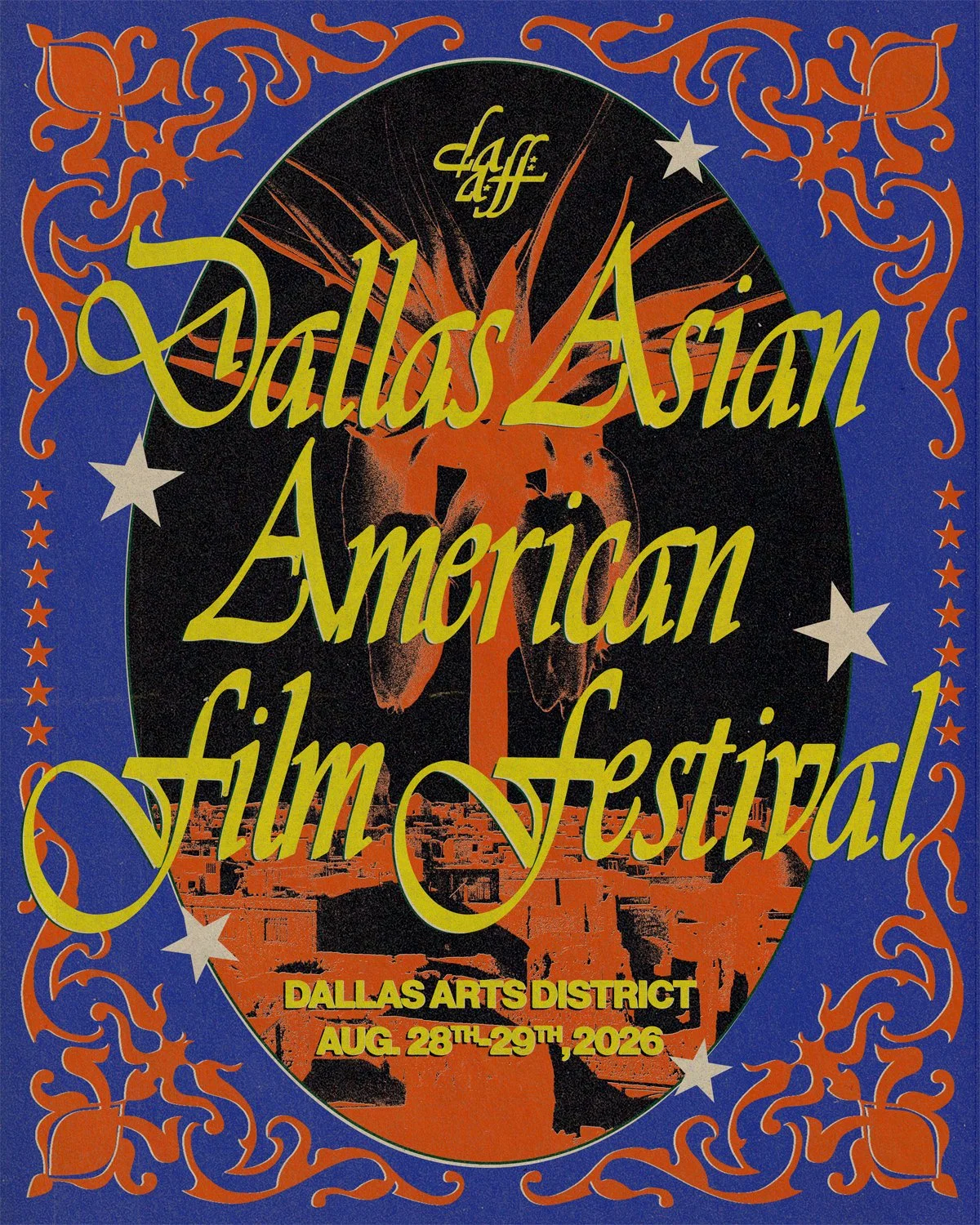
The Dallas Asian American Film Festival opens today for the first time, running August 28 and 29 across three of the most recognizable buildings in the Dallas Arts District. Ten short films and one feature. Every screening free and open to the public. Seven of the ten shorts were made by Texas filmmakers, and half came out of North Texas specifically.
That last number is the whole argument.
What is playing and where
The festival is presented by the Dallas Asian American Art Collective, a nonprofit that goes by DAAART, and it is spread across the Dallas Museum of Art, the Nasher Sculpture Center and the Crow Museum of Asian Art. Three institutions on the same few blocks, which turns a two-day program into something closer to a neighborhood takeover than a screening series.
Tickets are free but limited, and the collective has been directing people to daaart.org for the schedule and reservations. If you are reading this the morning of, check availability before you drive.
The programming brief was specific. Shorts had to run fifteen minutes or under, be made between 2023 and 2026, and be directed by, led by, starring, or centering Asian American and Asian diasporic people living in the United States. Not films about Asia. Films about here.
Why a hyperlocal Asian American film festival matters
Dallas already has an Asian film festival. The Asian Film Festival of Dallas has been running for a quarter century and held its 25th edition this July at the Angelika. It is a good festival with a real audience. It is also, by design, a festival that programs films from Asia alongside diaspora work, which is a different mission.
DAAFF is doing something narrower on purpose. It is a hyperlocal festival built around Asian Texan talent, and the emphasis on North Texas production is not a limitation it is apologizing for. It is the point.
Here is the structural problem it is answering. The Asian American film ecosystem in this country is concentrated in two cities. The Asian American International Film Festival is in New York and just wrapped its 49th edition. CAAMFest is in San Francisco. The Los Angeles Asian Pacific Film Festival is in Los Angeles. Those are the festivals that programmers, agents and acquisitions executives actually attend, and they are all on the coasts.
Texas has one of the largest and fastest growing Asian American populations of any state in the country. The Dallas-Fort Worth metro has substantial Vietnamese, Indian, Chinese, Korean, Filipino and Pakistani communities, many of them in Plano, Richardson, Irving and Garland. A filmmaker who grows up in that landscape and wants to make work about it has historically had two options: move, or make the work and have nowhere local to show it.
A festival is infrastructure. It is not the same as a distribution deal, but it is the thing that lets a filmmaker finish a short knowing there is a screen at the end of it, and it is where the person who will produce your next project sees your last one.
What to expect from a first edition
Be realistic about scale. Eleven films over two days is a modest program, and a first-year festival is going to look like a first-year festival. What it has is placement. The Dallas Museum of Art, the Nasher and the Crow are not community center basements. Those are the institutions that define what Dallas considers art, and DAAART getting all three to host in year one is a statement about legitimacy that most new festivals spend a decade trying to earn.
The Crow Museum is a particularly loaded choice. It is a museum of Asian art, meaning classical work, largely made in Asia, largely centuries old. Screening contemporary Asian American shorts inside it puts a specific question in the room: whether the Asian American present belongs in the same building as the Asian past, or whether those are two different subjects that a museum has been treating as one. Programming a film about a kid in Garland next to a classical collection is an argument, whether or not anyone stated it that way.
The thing not to write about it
The easy version of this story frames Texas as a surprise. Asian American art, in Dallas, who knew. That framing is both condescending and factually lazy, and it is the default in national coverage every time something like this happens outside of Los Angeles or New York.
There have been Asian Texans for well over a century. Chinese laborers came to Texas with the railroads in the 1870s. Vietnamese refugees resettled along the Gulf Coast in the mid-1970s and built a significant presence in the shrimping industry there, which produced its own violent backlash and its own body of American history. Indian and Pakistani engineers arrived with the telecom corridor in Richardson through the 1980s and 1990s. None of this is new. What is new is a festival.
The reasonable coverage question is not why Dallas. It is why it took until 2026, and the honest answer has less to do with the community and more to do with where arts funding and film industry attention have historically pooled.
If you are going
Screenings run both Friday and Saturday across the three venues. Free admission, limited capacity, reservations through DAAART. The collective is at @daaartclub on social if you want the day-of updates, which for a first-year festival are usually where the real schedule lives.
Go on Friday if you can. Opening night audiences at a first edition are almost entirely people who made the thing happen and people who are in the films, and that room is worth being in.
Related 88tumble coverage: the Asian American International Film Festival's 49th edition.