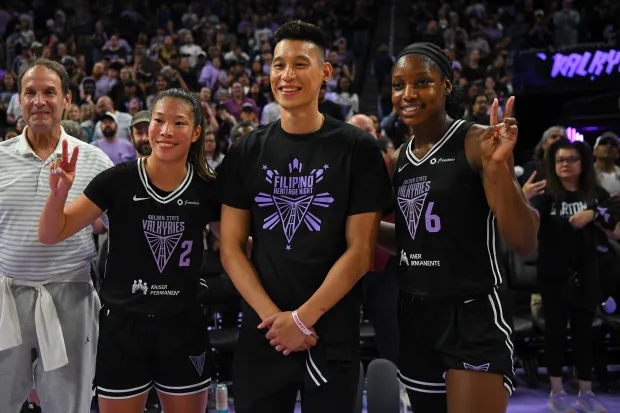
Kaitlyn Chen and Natalie Nakase share a bench in Oakland, and the shorthand version of why that matters gets repeated every time the Golden State Valkyries come up. Chen is the first player of Taiwanese descent drafted into the WNBA. Nakase is the first Asian American head coach in league history. Two firsts, one roster, easy headline.
The more useful story is that neither of them arrived by accident, and the infrastructure that produced them has been running for decades without much attention from anyone outside it.
Who is Kaitlyn Chen
Chen grew up in San Marino, California, the daughter of Taiwanese immigrants. She played three seasons at Princeton, where she was named the Ivy League tournament's most outstanding player three times, then transferred to Connecticut for a final year that ended in a national championship. At UConn she averaged 6.9 points, 3.4 assists, and 1.2 steals across 23 minutes a game, which is the stat line of a guard whose value does not show up cleanly in a box score.
The Valkyries took her 30th overall, in the third and final round of the 2025 draft. Third-round picks are not supposed to stick. Chen made the inaugural roster anyway.
Through 29 appearances this season she has averaged 7.4 points, 2.0 assists, and 1.2 rebounds in just under 15 minutes a night. In June she came off the bench against the Dallas Wings, scored 15, and turned an 11-point deficit into a Golden State win. That is the game people point to. It is also the least representative one, because most of her contribution looks like the other 28.
Who is Natalie Nakase
Nakase spent more than sixteen years coaching professional basketball before Golden State hired her, including three seasons as first assistant with the Las Vegas Aces during their back-to-back championship runs in 2022 and 2023. She became the first Asian American head coach in WNBA history when the Valkyries named her, and then did something harder than getting hired.
She won 23 regular season games with an expansion team, a single-season record for a first-year franchise, took that team to the playoffs, which no expansion franchise had done in its inaugural season, and won Coach of the Year. Being first is a matter of who does the hiring. That season was hers.
The circuit nobody covers
Here is the detail that reframes both careers. Chen and Nakase both came up through the North South Asian American high school basketball tournament, a fixture of the AAPI amateur basketball world that has been developing players in California and beyond for generations. Two women who reached the top of American professional basketball passed through the same community gyms, a coaching generation apart.
Asian American basketball leagues, Chinese American and Japanese American tournament circuits, church leagues, and community organizations have run continuously in California since the mid-twentieth century, in part because mainstream youth sports were not always available to the families who built them. They were never designed as a pipeline to the WNBA. They were designed as places to play. That they have now produced a head coach and a drafted guard on the same team is a byproduct of infrastructure that existed for its own reasons.
This is the part that gets lost when the coverage stops at first. A first implies a break in the pattern. What Chen and Nakase actually represent is the pattern finally becoming visible from the outside.
What to watch through the rest of the season
The Valkyries are past their novelty year, which is when expansion teams usually regress. Chen's minutes and role are the thing to track, because a third-round guard who survives year one and grows in year two is a different kind of player than a feel-good roster story.
The other thing worth watching is whether the league treats Nakase's Coach of the Year season as a data point or an anomaly. Hiring cycles will answer that faster than any statement will.
The framing to avoid
Chen is not a mascot for Taiwanese American representation, and she should not be written as one. She is a professional point guard on a playoff-caliber roster who has to earn minutes against the best players in the world every night. Nakase is not a diversity milestone. She is a coach with a championship-organization pedigree who beat every expectation set for an expansion franchise.
The representation matters because the basketball is real. Reverse the order and you get the wrong story. For related reading, see our coverage of how AAPI visibility gets counted in other industries.