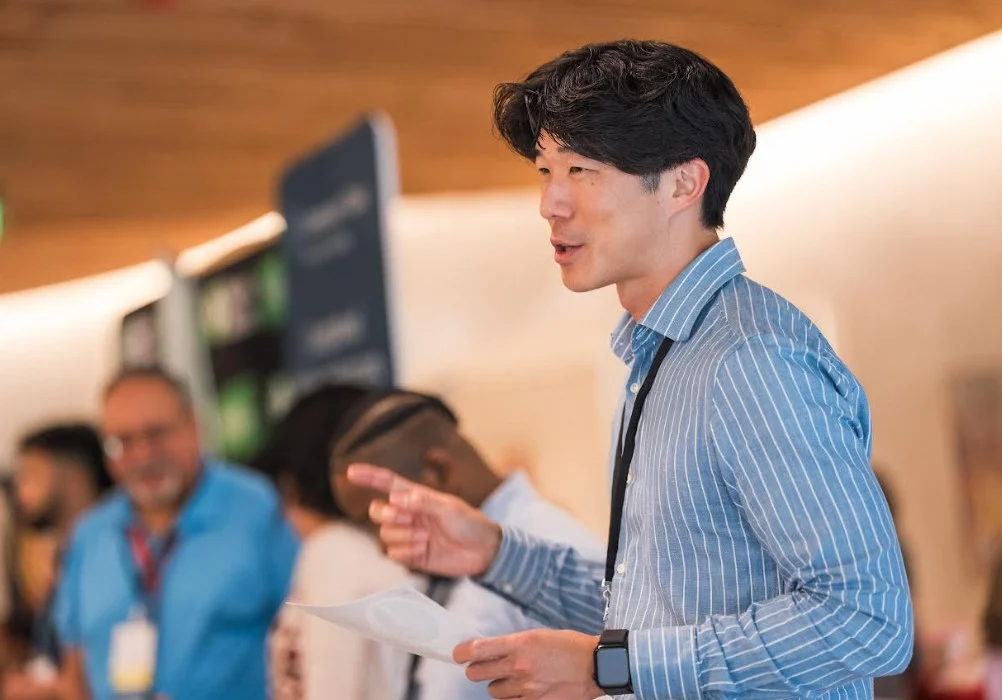
Colby Takeda thinks the most important people in American health care are the ones most health systems cannot see. Takeda, 37, is co-founder and CEO of Pear Suite, a Los Angeles company that builds software and support services for community health workers, the trusted neighbors, outreach workers and navigators who help people get to a doctor, find food or fill out a form. Founded in 2021 with engineer Nick Lockett, Pear Suite has grown to 55 employees and serves 300,000 members across the country, according to AsAmNews.
Who is Colby Takeda?
Takeda grew up in Hawaiʻi. As a high school student he volunteered at a nursing home, which is where his interest in elder care began. He earned an MBA from the University of Hawaiʻi at Mānoa and a Master of Public Health from UC Berkeley, then went on to run The Plaza Assisted Living in Honolulu, overseeing 90 staff members caring for 150 residents, AsAmNews reported.
It was later, working alongside community health workers, that he saw the problem Pear Suite set out to solve. The workers were effective. Their tools were not. Much of their time went to outdated systems and paperwork rather than to the people they were trying to help.
What does Pear Suite do?
Pear Suite gives community-based organizations a platform for what Takeda described to AsAmNews as "social needs screening, helping people build care plans, helping people find resources, and then submitting claims to health plans."
That last part is the business insight. In recent years, more health plans, especially in Medicaid, have begun paying for community health worker services and for help with social needs like food and housing. But small community organizations often lack the billing infrastructure to get paid. Pear Suite handles that layer so a neighborhood nonprofit can be reimbursed for work it was already doing.
The company operates a network of about 3,000 community health workers who speak 20 languages, according to AsAmNews. Takeda's stated goal is to hire 10,000 and reach millions of people a year.
Why this matters for Asian American and Pacific Islander communities
Language is one of the biggest barriers to care for immigrant families. A clinic can have perfect services and still fail an elder who speaks Cantonese, Tagalog, Vietnamese, Chuukese or Marshallese if nobody can explain the next step. Community health workers bridge that gap, often because they come from the same communities they serve.
That role has become more urgent this year. As federal policy changes push immigrants away from public benefits and threaten Medicaid coverage for some groups, the people most likely to keep a family connected to care are the trusted messengers in the neighborhood. A network that pays them and gives them better tools is, in effect, health infrastructure for communities the system has historically underserved.
The trust problem
Takeda is candid about the hardest part of the job. Community organizations are wary of tech companies, and for good reason. "Everyone's skeptical," he told AsAmNews, describing how groups react to for-profit companies arriving with offers: "what do you want from us?"
That skepticism is the right instinct, and it is the real test for Pear Suite. Health tech has a long record of companies that arrive with grant money and big promises, collect data and leave. A model built on community health workers only works if those workers and their organizations are treated as partners, paid fairly and kept in control of their relationships with the people they serve.
The bigger picture
Asian American founders are well represented in tech, but far fewer build companies around care work, elder support or community health, fields that are less glamorous and harder to scale. Takeda's path, from a Honolulu nursing home to a national platform, is a reminder that some of the most consequential health innovation is not a new drug or device. It is figuring out how to pay the people who already know how to help.
Whether Pear Suite reaches 10,000 workers will depend on health plans continuing to fund this work. If they do, the community health worker may become one of the most important jobs in American health care, and one of the best paths into it for bilingual members of immigrant communities.