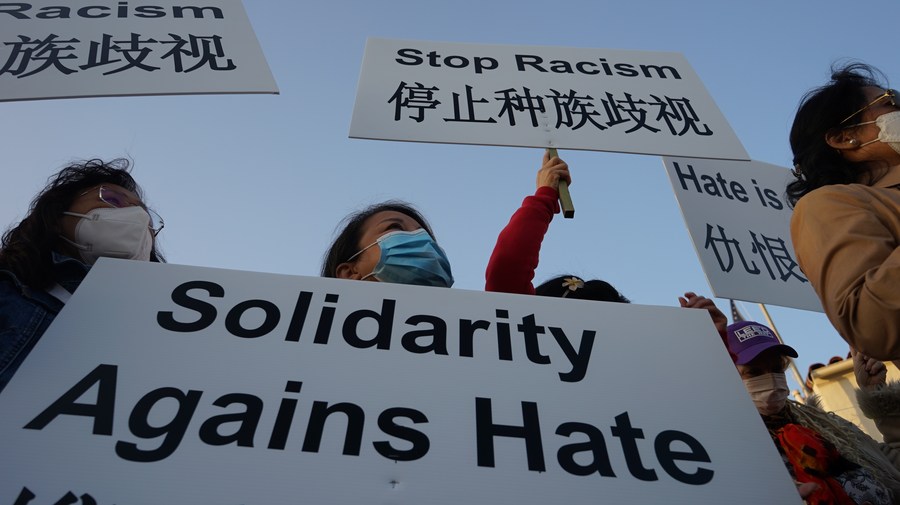
Stop AAPI Hate's new report finds that anti-immigrant hostility now runs through a majority of the anti-Asian hate acts reported to the organization. The share rose from 42% in 2023 to 62% in the first half of 2026, according to "License to Hate: Anti-Asian Racism in an Era of Anti-Immigrant Politics," released October 14, 2026.
The finding changes how the country's best-known tracker of anti-Asian hate describes what it is seeing. Hate aimed at Asian Americans is increasingly delivered in the language of immigration enforcement, and offenders are increasingly threatening to call ICE.
What does the License to Hate report find?
The report analyzes hate act reports submitted to the Stop AAPI Hate reporting center between January 1, 2023 and June 30, 2026, looking for anti-immigrant language and narratives. The headline number is the climb from 42% to 62%. Inside that group of reports, the numbers sharpen.
- Acts that included threats of physical attack or actual physical harm rose from 13% in 2023 to 27% in the first half of 2026.
- Acts that involved immigration status policing rose from 3% to 13% over the same period.
- 87% of the anti-immigrant hate acts used what the report calls the exclusion narrative.
The release does not state a sample size or a detailed methodology. Because the data comes from reports submitted to the center, the figures describe the reports Stop AAPI Hate received. Editors citing the percentages should say so.
What are the three narratives of anti-immigrant hate?
The report sorts the language it found into three narratives. Exclusion portrays Asian people as outsiders who do not belong, based on race, ethnicity, religion, country of origin or perceived foreignness. It is the most common of the three. Societal threat portrays Asian people as dangers to the nation, the economy or the social order, and the report says it is increasing. Immigration status policing subjects Asian people to immigration-related scrutiny, such as threats to call ICE or demands for proof of status. That one is increasing too.
The release carries the second-person threat in its own title: "I'm Going to Call ICE."
What Stop AAPI Hate's leaders are saying
Cynthia Choi, co-founder of Stop AAPI Hate and co-executive director of Chinese for Affirmative Action, put the organization's reading plainly. "Hate thrives when leaders give it permission to," she said. She added: "Our research makes clear that Trump's anti-immigrant agenda is emboldening people to commit acts of anti-Asian racism."
That causal claim is the organization's own assessment of its data, and it is worth reporting as such. The post was produced and paid for by Stop AAPI Hate Action, a 501(c)(4).
Manjusha Kulkarni, co-founder of Stop AAPI Hate and executive director of the AAPI Equity Alliance, framed the problem as one of connection. "Political rhetoric, policies, and hate acts don't operate separately," she said, adding that "we have no option but to challenge the rhetoric, policies, and systems that make this type of hate possible."
Kulkarni also noted that about 65% of the U.S. Asian population are immigrants, the highest share of any major racial group. The release does not source that figure.
Why this matters for Asian American media
For newsrooms, creators and brands covering Asian America, the report is a prompt to stop treating immigration coverage and hate incident coverage as two separate beats. The people who experience one are often being targeted through the other.
It also raises the bar on how the numbers get used. A rise from 42% to 62% is a striking line, and it will travel quickly. The responsible version carries the time period, the source of the reports and the fact that the sample size has not been published. 88tumble will keep reporting on the data as fuller methodology becomes available.
Read the full release on the Stop AAPI Hate website.