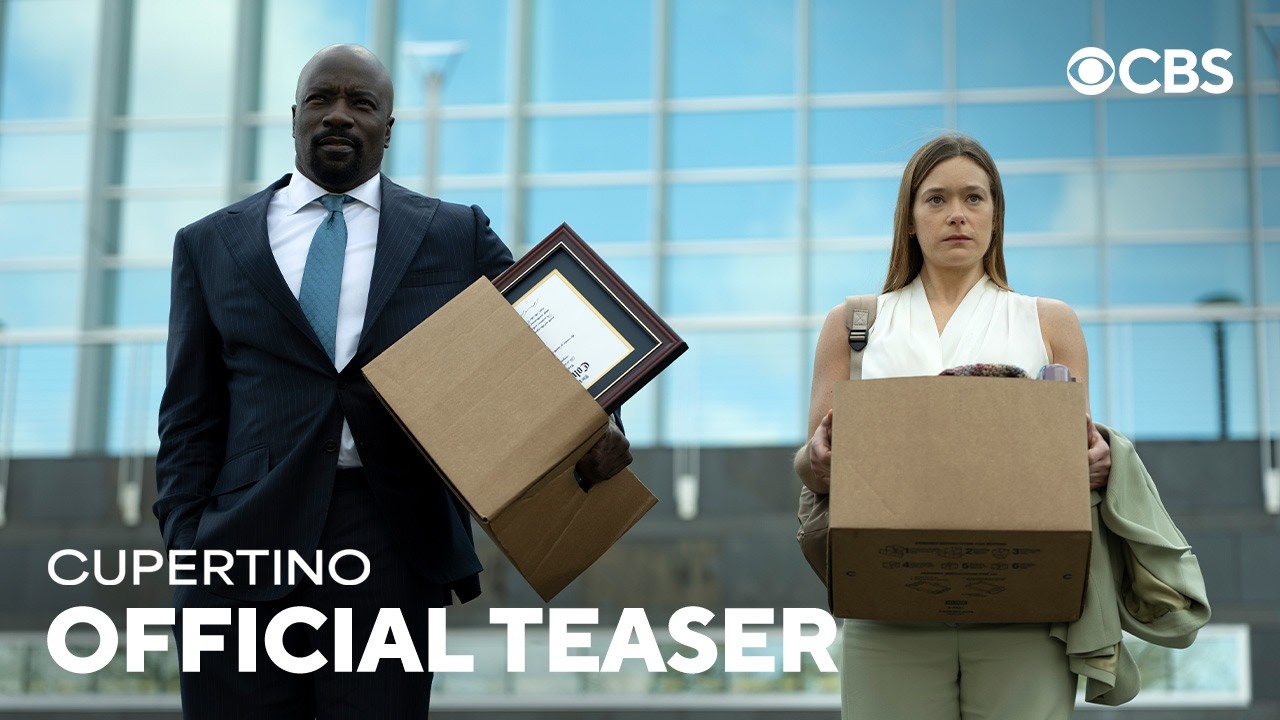
CBS named its new legal drama after Cupertino, California, a city that is roughly seventy percent Asian American, and cast one Asian American actor among its six series regulars. The Cupertino Asian American representation gap became a talking point within hours of the trailer dropping in late July, and the show premieres Thursday, October 8 at 10 p.m. Eastern regardless.
The easy version of this story is a backlash roundup. The harder and more useful version asks what the one Asian character is doing in the script, because that answer says more about how Hollywood understands Silicon Valley than the headcount does.
What Cupertino is and who is in it
The series comes from Robert and Michelle King, the creators of The Good Wife and Evil, and reunites them with Mike Colter. Colter plays Michael, a lawyer cheated out of his stock options by the tech startup that employed him. He partners with Olivia, another recently fired attorney, and the two build a practice representing people the tech elite have taken advantage of.
The series regulars are Colter, Rachel Keller, Ella Stiller, Nik Dodani, Busy Philipps, and Reneé Elise Goldsberry. Dodani, best known from Atypical, plays Vikram Malhotra, described as a coder with a comic sensibility who seeks out Michael and Olivia after his own employer turns on him.
So the cast is not monochrome. Colter and Goldsberry are Black, and this is a Kings production, which historically means a writers room more interested in institutional rot than in comfort. The problem is narrower and more specific than "no diversity."
The problem is not the count. It is the position.
In a show about who has power in Silicon Valley and who does not, the lawyers hold the power. They choose cases, they argue, they win. The clients are the people things happen to.
Vikram Malhotra is a client. He is the coder who gets exploited, then hires someone else to fight for him. He is also, per the descriptions released so far, the comic one.
Set that against the actual composition of the industry the show is dramatizing. Asian Americans are overrepresented in exactly the role Dodani plays, the individual contributor writing code, and dramatically underrepresented in the roles the show hands to everyone else. This is the pattern the data has shown for years: hired readily into technical work, promoted rarely into the positions where decisions get made. The bamboo ceiling is not a metaphor in Santa Clara County. It is a documented promotion pattern.
A show set in Cupertino that puts its Asian American character in the individual contributor seat and its advocates elsewhere has, without apparently intending to, reproduced the org chart it means to critique. That is a more damning observation than a cast count, and it is also more interesting, because it is fixable in the writing rather than only in the casting.
Why Cupertino specifically
Cupertino is not a generic Silicon Valley stand in. It is a city whose demographic transformation over three decades is one of the clearest stories of Asian American suburban settlement in the country, driven substantially by H-1B engineers from India, Taiwan, and mainland China building families around a school district that became nationally competitive as a direct result.
Naming a show Cupertino invokes that. It is a specific place with a specific population, and the name is doing work in the title that the cast list does not support. If the show were called Palo Alto or simply Valley, the gap would be less conspicuous. CBS chose the most Asian American city name available and then wrote around it.
Brian Tong, a tech journalist who grew up there, put it bluntly on social media, asking where all the Asian people were. That reaction traveled because it was obvious to anyone who has been to the place.
Has CBS done this before?
Yes, and the precedent is close enough to be uncomfortable. Nash Bridges ran on CBS from 1996 to 2001, set in San Francisco, a city that was roughly a third Asian American at the time, with no Asian American series regulars. Three decades on, the network named a show after a city that is seventy percent Asian American and cast one.
Progress in television representation is usually measured against the prior decade, which tends to flatter everyone. Measured against the place being depicted, the numbers look different. We ran into the same arithmetic covering this year's Emmy nominations, where one show carried the community's entire showing while the broader acting slate went backward.
What good would actually look like here
It is worth being concrete rather than just aggrieved, because "cast more Asian people" is a note that produces tokens.
The show has a full season to establish that Vikram is not a sidekick with a punchline, and a recurring and guest structure that could put Asian American characters on both sides of the cases, as opposing counsel, as founders being sued, as the venture capitalists funding the defendants. Silicon Valley's Asian American population is not uniformly sympathetic, and a show willing to cast an Asian American antagonist would be making a more confident statement than one that adds a second good guy.
The Kings have a track record of letting supporting characters take over. Evil and The Good Wife both promoted actors the audience responded to. Dodani is a genuinely funny performer, and if the room writes toward him the position problem could resolve on its own.
That is the optimistic read, and it requires the show to notice. The trailer suggests it has not yet.
Nik Dodani is not the problem
It is worth separating the actor from the structural complaint, because these conversations have a habit of turning into referendums on the one person who got cast.
Dodani has been consistently good in work that gave him less than he could handle. On Atypical he played Zahid across four seasons and turned what was written as comic relief into the show's most reliably watchable character, which is the specific skill that matters here. He is also a working stand up, and Vikram is described as having a comic sensibility, so the casting is coherent rather than arbitrary.
The frustration is that this is now a familiar career shape. A talented South Asian American performer gets the funny friend, does more with it than the page allowed, and waits for a role where the humor is a choice rather than a job description. That is a structural pattern about what parts exist, not a complaint about who is playing them.
What Asian American writers in the room would change
Casting fixes are visible and shallow. The deeper variable is who is breaking the stories.
A writers room with Asian American voices working in Silicon Valley would likely reach for material that is currently missing from the premise entirely. The H-1B holder who cannot leave an abusive employer because status is tied to sponsorship. The immigrant founder who becomes the exploiter once the company scales. The layer of Asian American middle management that absorbs blame for decisions made above them. These are legal stories, they are Silicon Valley stories, and any one of them would fit a David versus Goliath format.
CBS has not disclosed the composition of the room. That is standard and also the piece of information that would tell you most about how the season is likely to go.
What to watch when it premieres
October 8 at 10 p.m. Eastern on CBS. The questions worth tracking are simple. Does Vikram get an interior life or a running joke. Does the show ever put an Asian American character in a position to decide something. And does a series about who Silicon Valley exploits ever acknowledge that the people writing its code are the ones the industry has been quietest about promoting.
A legal drama about power in Cupertino has an unusual opportunity in front of it. The concern, three months out from a premiere and one trailer in, is that nobody in the room noticed the opportunity was there.