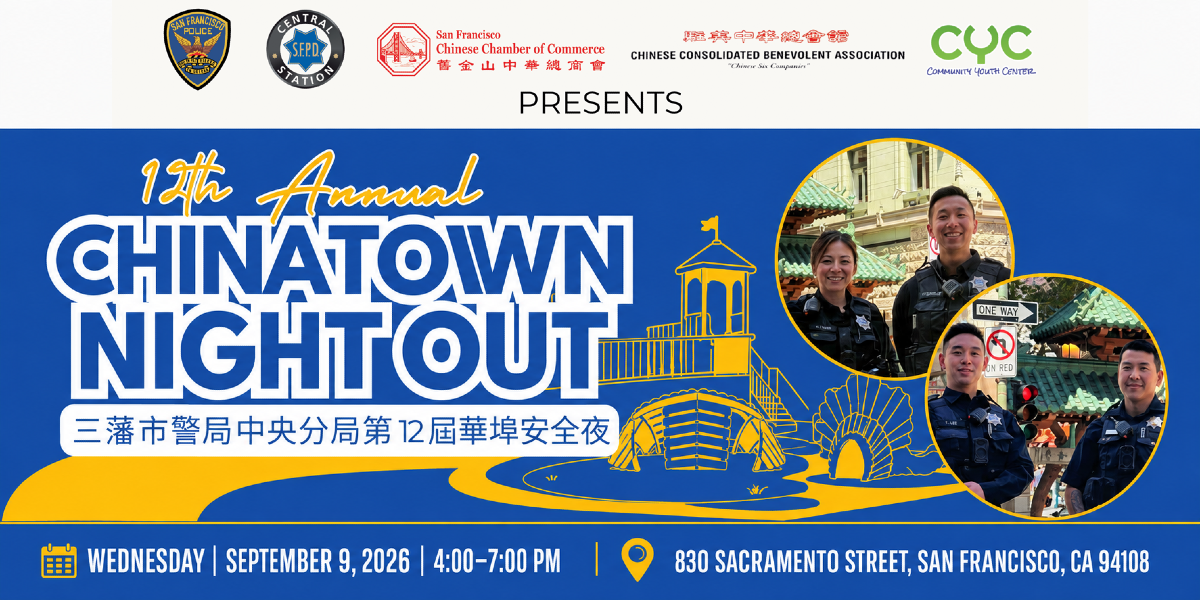
Chinatown Night Out returns to San Francisco on Wednesday, September 9, from 4 p.m. to 7 p.m., and this year it happens on the basketball court at Willie "Woo Woo" Wong Playground, 830 Sacramento Street. The 12th annual event brings San Francisco Police Department officers, the fire department, city agencies and more than 20 community organizations into one square block of Chinatown for cultural performances, children's activities, a live raffle, free giveaways and a hot meal. Organizers expect around a thousand residents.
It is a neighborhood block party with a civic purpose, and it is also, this year, a study in how complicated the word safety has become for Asian Americans in the Bay Area.
What is Chinatown Night Out and when is it?
Chinatown Night Out is a free annual community safety event in San Francisco Chinatown, held this year on September 9, 2026, from 4 to 7 p.m. at the Willie "Woo Woo" Wong Playground basketball court on Sacramento Street. It is open to everyone, costs nothing to attend, and is built around getting residents into the same space as the officers and agencies who work their blocks. Attendees can visit resource booths on crime prevention, scams, phone theft and personal safety, and meet the people behind the badge without an emergency forcing the introduction.
The venue is new. Portsmouth Square, the plaza that has anchored the event for years, is still under construction, so the gathering moved a few blocks uphill to the playground named for the Chinatown-born basketball player who became one of the first Asian Americans to play professionally in the United States.
An event that grew from a handful of groups to twenty
Robert Chiang, president of the Chinatown Chamber of Commerce, framed the anniversary as a story about scale. "Over the past 12 years, Chinatown's Night Out has grown from an event involving just a few community organizations into a collaborative effort involving more than 20 community organizations today," he said through a translator at a press conference announcing the event.
That growth is the part worth sitting with. Chinatown Night Out started small, in the way neighborhood things do, and became infrastructure. Chiang said the day matters most for the residents least equipped to navigate a police department on their own, describing it as "especially important for our senior and small business owner who may face language and cultural barriers."
That is a precise description of who actually gets left out of public safety conversations. A Cantonese-speaking grandmother who was pushed on Stockton Street in 2021 and never filed a report is not served by a hotline. A restaurant owner who has been robbed twice and cannot spare the hours to sit in a station is not served by a community meeting held in English at 6 p.m. downtown. Michael Wong, senior director at Community Youth Center of San Francisco, said organizers expect "1,000 local residents to come out and interact with the law enforcement personnel." The value of that number is not the crowd. It is that the crowd includes people who would otherwise never make contact.
Mayor Daniel Lurie put the case for the event in the language of relationships. "Public safety works best when officers build strong relationships with the people they serve, when beat officers know the store owners on their block, when an officer stops to help a senior, and when public safety teams understand the neighborhood and know the people they are there to protect," he said. "Chinatown Night Out builds on those relationships."
Chinatown asked for this. That request has a history.
It would be easy, and wrong, to read a police presence in Chinatown as something imposed on the neighborhood. Chinatown asked. After the surge in anti-Asian assaults that began in 2020, after elderly residents were knocked to the sidewalk in daylight, after merchants watched foot traffic collapse, Chinese American community groups in San Francisco spent years lobbying for more patrols, faster response times and officers who spoke Cantonese and Mandarin. Chinatown Night Out is downstream of that organizing.
There is a version of Asian American politics, popular online, that treats any community request for policing as a betrayal. It flattens a real disagreement. Chinatown's seniors are not confused about who they are and what they want. They watched their neighbors get hurt and they asked the city for help, and the city, slowly, answered.
The other thing happening in San Francisco this month
Here is where the day gets complicated. In the same city, in the same season, Asian immigrant families have been avoiding San Francisco International Airport. Attorneys have reported arrests of Bay Area residents at SFO, and community organizations have fielded calls from visa holders and green card families asking whether it is safe to fly to see relatives. Some are canceling trips. State Senator Scott Wiener has publicly urged people with uncertain immigration status to think hard before getting on a plane.
So one set of Asian American families in San Francisco spent this decade asking for more law enforcement in their neighborhood, and another set spent this year rearranging their lives to avoid federal agents. Both groups are Asian American. Sometimes they are the same household, a citizen grandmother who wants a beat officer she recognizes and a son-in-law on a work visa who will not go near an airport.
These two facts do not cancel out and they do not resolve into a slogan. Local police and federal immigration enforcement are different agencies with different mandates, and San Francisco's sanctuary ordinance limits cooperation between them. Residents know that in theory. Trust does not always follow the org chart, and a family that has learned to read a uniform as a risk does not sort agencies before deciding whether to cross the street.
What to actually watch for on September 9
The useful question at an event like this is not whether it should exist. It is what the community gets out of it after the tables fold up.
Watch whether the resource booths carry material in Cantonese, Mandarin and Vietnamese, or only English with a translator on call. Watch whether the organizations present include immigrant legal services, not only crime prevention. Watch whether anyone from the city addresses the enforcement anxiety directly rather than leaving it as the thing nobody says out loud on a playground full of families.
Chinatown Night Out works because it is small and specific and because the same people show up year after year until the officer and the shop owner know each other's names. That is genuinely worth something. It is also, on its own, not the whole of what safety means in San Francisco Chinatown in September 2026.
The event is free. Bring your neighbors. Ask hard questions of the people at the booths, because they came to be asked.
Related 88tumble coverage: The Bill to Bring Deported Southeast Asian Refugees Home Is Stuck and Jollibee Is Back on Market Street After Fifteen Years.