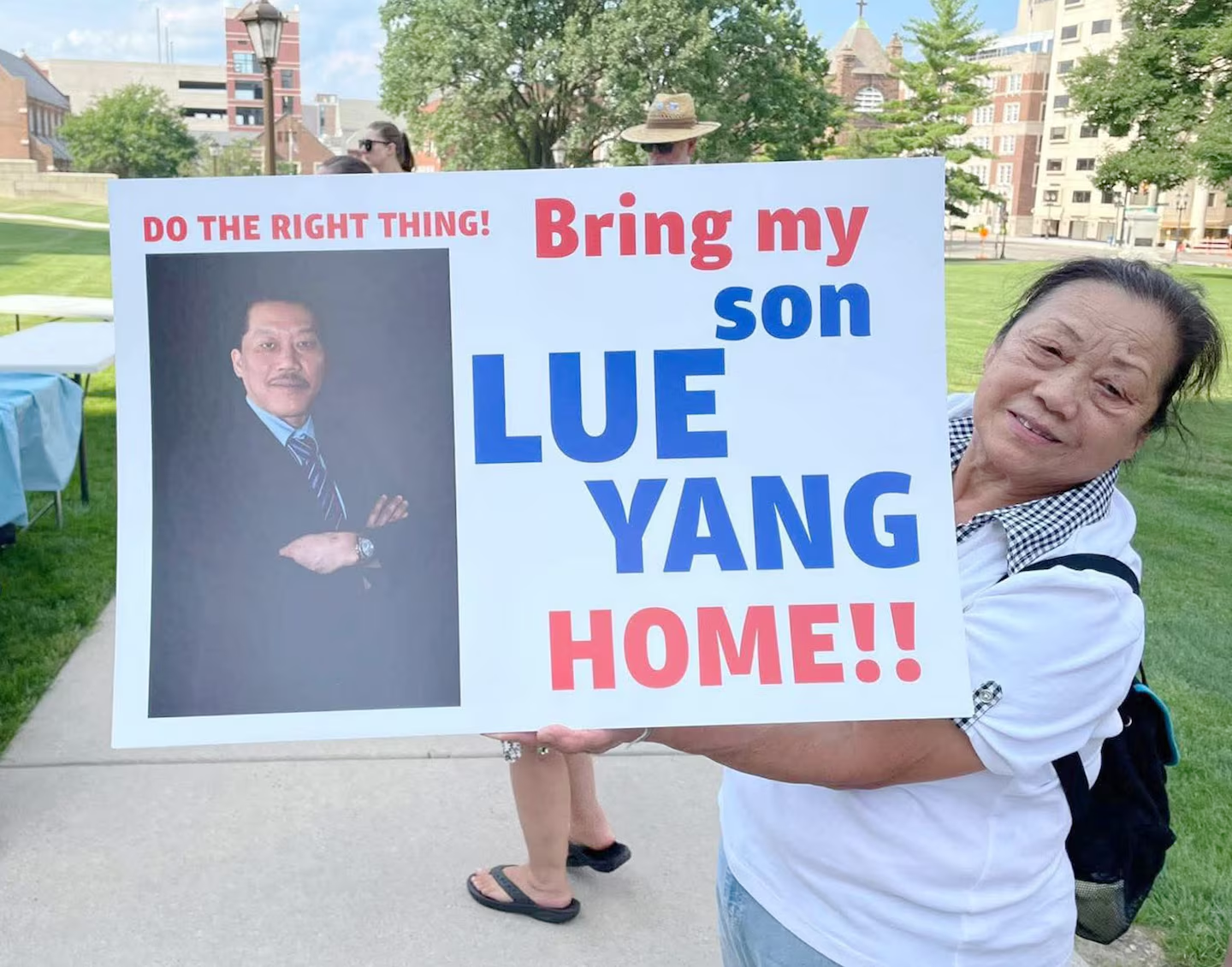
The Southeast Asian Deportation Relief Act would end the deportation of Cambodian, Lao, and Vietnamese refugees who arrived in the United States by 2008, protect more than 15,000 people currently living under final orders of removal, and create a pathway for the more than 2,000 already deported to come home and fight those orders. It was reintroduced in February 2026 by Representatives Ayanna Pressley, Judy Chu, Pramila Jayapal, and Zoe Lofgren. It carries more than 100 organizational endorsements. It has not received a floor vote.
That gap, between the coalition behind SEADRA and the legislative attention it has drawn, is the story.
What the Southeast Asian Deportation Relief Act would do
The bill is narrower and more concrete than its title suggests. Four provisions:
- Limit the Department of Homeland Security's authority to detain or deport refugees from Cambodia, Laos, and Vietnam who arrived in the US by 2008.
- Permanently authorize employment eligibility, with five-year renewals, for Southeast Asians living under a final order of removal.
- End in-person ICE check-ins and replace them with virtual check-ins at five-year intervals for people on orders of supervision.
- Create a pathway for refugees already deported to return to the US and challenge their removal orders.
The employment and check-in provisions are the ones that would change daily life fastest. A person under a final order of removal who reports to ICE in person is a person who structures their entire year around whether they will come home from an appointment.
Why Southeast Asian refugees face deportation decades after arriving
More than 1.2 million refugees from Cambodia, Laos, and Vietnam were resettled in the United States following American military intervention in the region, the largest refugee population ever resettled in this country. Many had fought alongside US forces. Many were fleeing genocide.
Most were placed in heavily disinvested communities with limited resources and no meaningful support for war trauma. A generation of Southeast Asian youth grew up in those conditions, and some accumulated criminal convictions decades ago. They served their sentences. Under current immigration law, a decades-old conviction can still trigger removal, which means these are people being punished a second time for something the system already closed.
The people facing deportation now are, in many cases, primary caregivers with US citizen children, no memory of the country they would be sent to, and no ties there at all. Congresswoman Lofgren, who represents San Jose, noted that her district has the largest Vietnamese population of any city outside Vietnam.
What has changed since the last time this bill was introduced
Pressley first introduced SEADRA in 2022 alongside Chu, Jayapal, Lofgren, and then-Representative Alan Lowenthal. The version now in Congress arrives against a materially different enforcement backdrop.
Between January and October 2025, according to the bill's sponsors, the Trump administration deported more Southeast Asian Americans in a single fiscal year than any prior administration: 46 people to Cambodia, 175 to Laos, and 676 to Vietnam. Sponsors describe individuals shackled hand and foot for flights lasting more than 50 hours, some to countries they had never set foot in, including Sudan and Eswatini. The administration also paused immigration applications for 75 countries, among them Cambodia, Thailand, Myanmar, and Laos.
Those figures come from the sponsors and should be read as such. They also have not been meaningfully contested.
Who is actually pushing this
The endorsement list is where the story stops being about Congress. More than 100 organizations signed on, and the composition matters: Southeast Asia Resource Action Center, Southeast Asian Freedom Network, Khmer Girls in Action, Hmong Innovating Politics, Hmong American Partnership, VietLead, Mekong NYC, MN8, the Cambodian Mutual Assistance Association of Greater Lowell, United Cambodian Community, Laotian American National Alliance.
Alongside them: Japanese American Citizens League, Nikkei for Civil Rights and Redress, Nikkei Progressives, the Wing Luke Museum, Stop AAPI Hate, the Sikh Coalition. The presence of Japanese American redress organizations on a deportation bill is not incidental. Those groups know what it looks like when the federal government decides a community's legal status is provisional.
"SEADRA is more than policy; it's a promise of healing, hope, and a future where Southeast Asian families are no longer torn apart," said Quyên Đinh, executive director of the Southeast Asia Resource Action Center. "SEADRA recognizes the full lives that people have built here and refuses to erase them."
Chhaya Chhoum, co-executive director of the Southeast Asian Freedom Network, put the organizing frame more plainly: "Our communities have organized, resisted and created new worlds when the old ones failed us."
Where this goes
SEADRA has 26 listed cosponsors and no Republican support. In the current House, that arithmetic does not produce a vote. Advocates know this. The bill functions right now as a record and as an organizing instrument, which is not nothing, but it does not stop a removal flight.
The near-term action is local. Long Beach, Lowell, Fresno, Philadelphia, Seattle, Providence, the Twin Cities, San Jose, Oakland: these are the places where SEADRA's constituency lives and where the organizations on that endorsement list operate. Deportation defense, post-conviction relief, and state-level pardon campaigns have kept individual people in the country while the federal bill waits.
Heading into the midterms, the honest question for AAPI voters is not whether SEADRA passes this Congress. It is which candidates can name it. For related reporting, see our coverage of how AAPI voters have moved in recent cycles.
Figures in this piece are drawn from the bill sponsors' February 2026 announcement. Readers can find the full text as H.R. 7608 on Congress.gov.